

Archery Comp Closes Out 2026 Desert Challenge Games
The humble orange traffic cone has no prouder role than the one it served today, as a kind of ground-based quiver for the archers standing above them, firing 12 rounds of six arrows each at targets sitting 10 to 50 meters out on the grass.
That was the scene this morning at Lehi Sports Park in Mesa, Ariz., as the 2026 Desert Challenge Games surged to their close with volley after volley of arrows across two sessions.
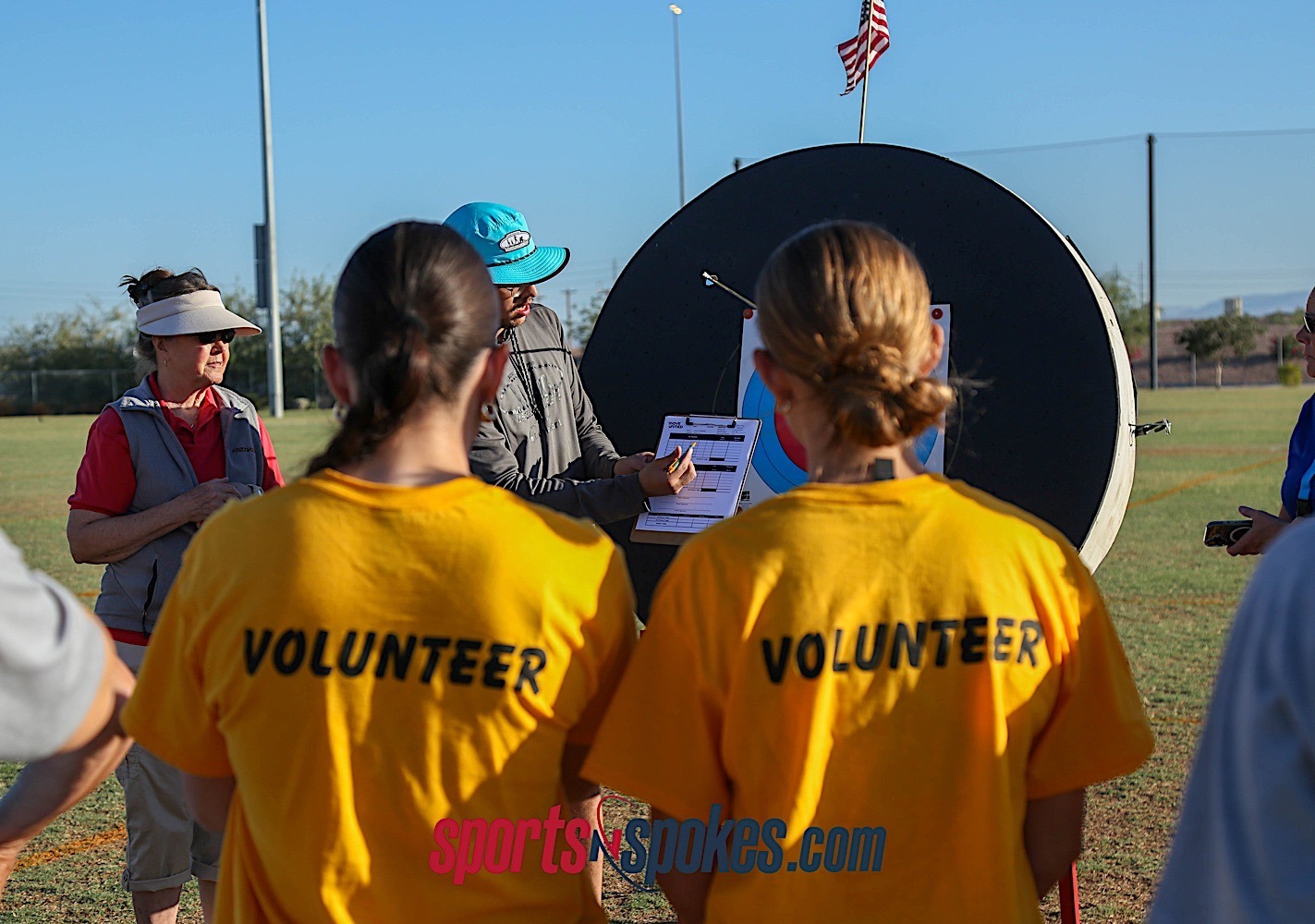
Brightly colored arrows were stacked next to a rack of gently swaying competition bows just this side of the tents where the 38 archers took their turns with the targets. Onlookers sat in tree shade on folding chairs in the grass.
Between his turns firing at target 3 from 20 meters, Michael Betts, 64 — pulling from a quiver on his back — explained to another visually impaired archer why he doesn’t use a triggering device to fire his arrow: “Too many steps in the process,” said Betts, preferring to manually release his volleys. Betts, competing in the visually impaired division using a tactile sight, finished with a score of 166.
A little farther down, at target 5 in the second session, 34-year-old Jeremy Watrus — a constant competitor for every day of the Desert Challenge Games — held back his bow with his teeth before each release. The tightly-packed arrows near the center of his target spoke to the effectiveness of his method, to the tune of a gold medal win in his division with a score of 477 at 20 meters.
Between each round, yellow-shirted volunteers, coaches, media and archers rushed the targets once the area was clear.
Down at the other end of archers’ row, shooting arrows with a confident pullback of the bow each time, was U.S. Air Force veteran Kenneth Nichols, 81, the most senior competitor at the 2026 Games, firing from 30 meters in the Open division. “I feel a little old in many ways, so that’s ok,” he told us when informed of this standing.
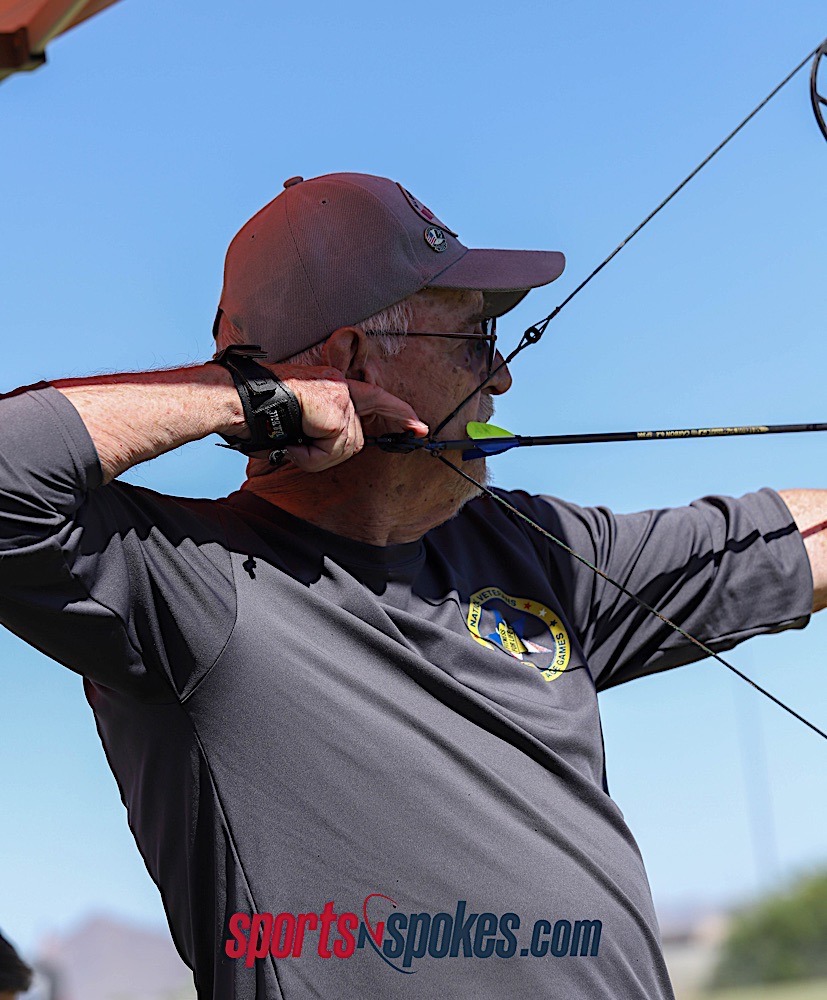
After a career in the Air Force that saw him building radar sites and flying AWACS in Vietnam, Cambodia and Laos, Nichols came home and ran an insurance agency for more than forty years.
And then he began to compete in golf at the National Veterans Golden Age Games, switching to archery only this year.
“I thought it was something new to try with a lot less walking, and it’s easier to carry the archery kit than it is the golf kit,” Nichols said. “I’m still trying to figure out what I’m doing.”
“I started about three months ago, and my friend from the VA took me out, got the bow fitted to me. We had three sessions. I paid for one coach up at Arizona Archery,” he continued.
“I didn’t expect to do a whole lot today. I scored, so I was okay with that. Only shot one arrow over the target,” Nichols laughed.
A longtime gun-shooting aficionado and self-confessed fine shot, the octogenarian said he was slightly frustrated that the bow and arrow “is just challenging me a bit more.”
“Your shoulders and your back will hurt after shooting a lot of arrows,” Nichols told us. “I didn’t score real high, but maybe next year or the year after if I keep doing it, I’ll get there.”
Nichols finished with a score of 219, in just his first archery competition. He plans to compete again this year at the National Veterans Golden Age Games in Tampa, Fla. at the end of June.
When the final scores were tallied, Al Marconi led all competitors with a top score of 622 points at 30 meters in the Masters 70+ division, followed closely by Corbin Beu with 620 points at 50 meters in the Masters 50+ division. Kervin Hertz rounded out the top three with 601 points at 30 meters in the Senior division.
And he’s the kind of competitor you find at these Desert Challenge Games, seemingly no matter the age — driven, focused and always pushing toward the next personal best.
Visit Arizona Adaptive Sports website for full results.