

The most memorable act of sportsmanship isn’t always a handshake or a gracious gesture. Sometimes, it’s simply returning to the ice.
Every once in a while, something brings a long-forgotten memory rushing back. This time, it was Cold War in Philly: Flyers vs. Russia 1976, a documentary about the NHL’s Philadelphia Flyers’ unforgettable 1976 game against the Soviet Red Army team.
I grew up in Philadelphia. On Jan. 11, 1976, I was 10 years old, just two days away from my birthday party. Most kids would have been counting down the hours.
But I was a Flyers fan. And the Flyers were about to play the Soviets. I didn’t understand politics, but I understood hockey. And this was a game that was worth understanding.
The Soviets arrived undefeated for the final game of their Super Series ’76 tour of North America. Waiting for them were the reigning back-to-back Stanley Cup champion Flyers, the “Broad Street Bullies” — physical, confrontational and relentless.
This was hockey in a brutal era. Helmets were optional and so were teeth. The Spectrum arena matched that intensity. More than 17,000 fans showed up expecting to see somebody get demolished; it almost didn’t matter who.
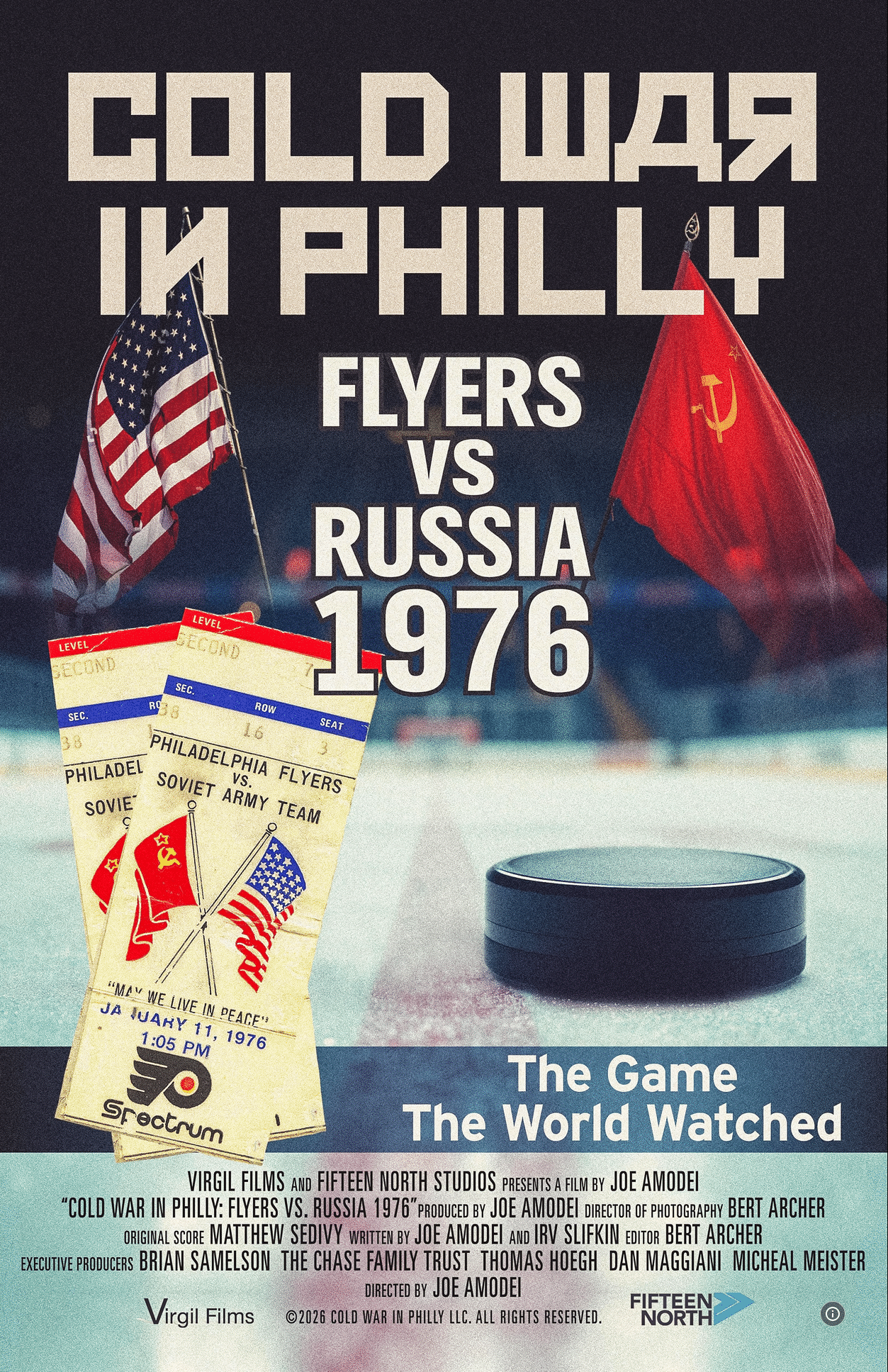
Cigarette smoke hung beneath the rafters. When there was a crushing hit, a fight or a disputed call, the noise didn’t build. It detonated.
The Flyers relied on grit, instinct and improvisation. The Soviets played with remarkable cohesion and precision, their movements so synchronized that they seemed to move as one.
It was also America’s Bicentennial year. Patriotic fervor was running high, and onto the ice skated a team representing, for many Americans, the nation’s greatest geopolitical rival.
This wasn’t just a hockey game. It felt like the Cold War on skates.
Early in the game, Flyers defenseman Ed Van Impe rushed out of the penalty box and leveled Soviet superstar Valeri Kharlamov with a violent check. No penalty was called.
To the Flyers, it was a hard but legal hit. To the Soviets, it was dangerous, ignored by the officials and unacceptable. The entire Soviet team left the ice in protest.
The Spectrum erupted. Play stopped for 17 minutes. And this is where the story gets complicated.
From the Soviet perspective, the Flyers’ aggressive style was unsportsmanlike. They believed the hit on Kharlamov was reckless and that the officials had failed to protect the players. Walking off the ice was their protest against what they considered an uncontrolled and dangerous game.
From the American perspective, however, the Soviets walking off the ice was the ultimate act of poor sportsmanship. To the Flyers and the raucous Philadelphia crowd, they weren’t standing up for the principles of the game. They were quitting because they were unwilling to accept the physicality of the Flyers’ style or the possibility of losing.
Both sides believed they were defending sportsmanship.
There’s an irony here, too. Protests were hardly encouraged in the Soviet Union. Yet on that January afternoon, the Red Army players made a very public statement by leaving the ice in front of thousands of Americans and a worldwide television audience.
Eventually, they returned.
I don’t believe they came back because they suddenly decided the Flyers were right. They hadn’t changed their minds about the hit. They hadn’t suddenly embraced the officiating.
There were financial and political realities involved. Flyers owner Ed Snider reportedly reminded the Soviets of the contract they had signed and made it clear that if they refused to return and finish the exhibition game, they wouldn’t get paid. Maybe they hated doing it. But a deal is a deal.
They swallowed their pride, returned to the ice and finished what they had started.
Within moments, the Flyers scored and went on to win 4–1, handing the Soviets their only loss of the North American tour.
But the score isn’t the point. The game was finished. And nearly 50 years later, that’s what I remember.
I was just a child. I didn’t speak their language. I couldn’t have explained their politics or their culture. I couldn’t have told you why they walked off the ice or what convinced them to come back.
But I watched them make a choice. They were angry. They believed they had been wronged.
Yet they returned.
I doubt many of the 17,000-plus raucous fans in the Spectrum learned that lesson. They cheered the hits, booed the Soviets and celebrated the Flyers’ victory.
But somehow, a 10-year-old kid took away something different. Fifty years later, that lesson is still with me. And that’s what I want to impart to wheelchair sports.
We sometimes talk about adaptive sports as though the athletes are teaching us something about overcoming disability. But that can miss something important.
They’re teaching us something about being athletes. The equipment may be different, and the rules may be adapted. But the heart of competition is the same. You train. You prepare. You compete.
And sometimes, you get frustrated. You get tired. You face disappointment. Sometimes, you think about quitting.
Then, you decide what kind of competitor you want to be. That’s where sportsmanship lives.
Sportsmanship isn’t just being gracious when you win or shaking hands when you lose. Sometimes, it’s having the discipline to put your frustration aside, return to the competition and finish what you started.
The Flyers and the Soviet Red Army never agreed about what happened that January afternoon. Perhaps they didn’t even agree about what sportsmanship meant.
But in the end, both teams honored the competition by finishing the game.
That’s sportsmanship.
The athlete’s challenge remains universal: When everything in you says, “I’m done. I want to quit. I want to go home,” what do you do?
I was a kid about to turn 11. They didn’t speak my language, and I didn’t understand theirs. Yet, somehow, they taught me a lesson that has stayed with me for 50 years.
Sometimes, the most important thing isn’t being right. It’s about coming back.
As always, share your thoughts at al@pvamag.com.