

Dwelling on one thing you can’t do will blind you from a hundred things you can do.
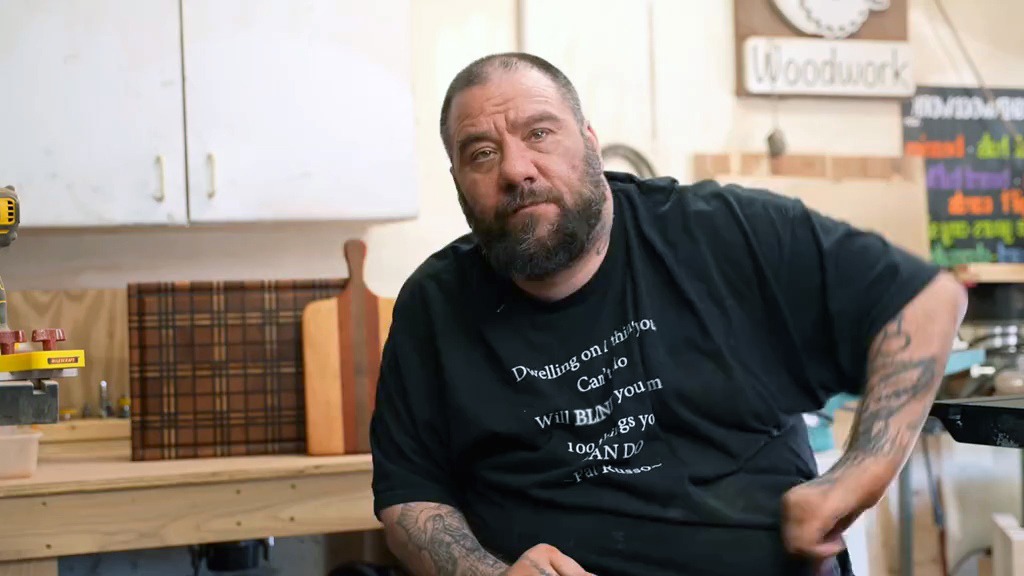
That is the personal motto of Pat Russo, a 42-year-old quadriplegic woodworker from Las Vegas, who has built a loyal following and a small business by refusing to accept the limits others placed on him. Known across social media as Keep It Pushin Woodwork, he creates cutting boards, charcuterie boards, custom urns and furniture — all handcrafted in a garage wood shop, with hands that do not work.
A Life Interrupted
Before his injury, Russo knew his way around a job site. Growing up, he worked in construction alongside his father — framing houses, adding rooms, remodeling bathrooms. It was practical, physical work, a long way from the fine woodworking he would eventually pursue. But it planted something early.
On March 21, 2000, Russo was a passenger in a car traveling through an intersection in Las Vegas when a driver ran a red light and struck his door. The impact broke his neck between his C6 and C7 vertabrae, leaving him a quadriplegic. He spent a week in trauma and intensive care before transferring to Craig Hospital’s spinal cord injury rehabilitation program in Englewood, Colo., followed by two years of outpatient rehabilitation in Las Vegas.
The road back was anything but smooth. Russo has openly talked about struggling with alcohol and substance use in the years after his injury, a period he partly blames on a system that focused on what he could not do rather than what he could.
“I felt that my only way of getting around doing things was limited,” Russo says. “But slowly, being by myself and doing my own thing, I learned that I was able to do more.”
For nearly two decades, he kept his distance from the wheelchair community, put off by what he described as a culture of negative stories in early group settings. It was not until he found wheelchair rugby that his view began to change.
“I got into wheelchair rugby and found out they are not all like that,” he says. “Once I got around people who were doing more things, it opened me up.”
The turning point came in 2017, when Russo enrolled in a personal development program called ChoiceCenter Leadership in Las Vegas.
“It kind of breaks down the walls you build up throughout life to protect yourself,” Russo says. “A lot of times you don’t realize you are limiting yourself. This made me think outside the box and take my life to newer levels.”
From Floating Shelves to Fine Woodworking
Woodworking was not part of the plan. In 2019, Russo stumbled across a YouTube video about building hidden-compartment floating shelves and thought, “I could do that.” He could — and he did — sell a few before interest faded.
Then, a neighbor threw out a set of 1940s Renaissance chairs, and Russo took them on as a refinishing project. He quickly found that refinishing was not for him. But while browsing YouTube, end-grain cutting boards, in which the ends of the wood fibers form the cutting surface, caught his eye — specifically, the patterns and designs he had never seen before. Something clicked.
“I never knew you could do all that in end grain,” Russo said. “Something just sparked in me and said I could do it. People still ask me how I figured it out, and to this day I couldn’t tell you.”
It is worth noting that Russo had no use of his fingers when he decided to pick up fine woodworking. Nobody in his life thought it was a good idea. Family members warned him he would injure himself. His grandfather repeatedly cautioned that he would cut his hand off in front of his daughter.
“I had a lot of actual discouragement,” Russo says. “I was motivated and determined, and that’s just what I was going to do.”
Adapting the Shop, One Problem at a Time
Russo has no use of his fingers and limited hand function due to his injury. He also has no trunk muscles, which means he must always keep one arm braced for balance while working. He has never relied on a catalog of adaptive equipment — he has simply figured things out as he goes.
His custom push stick for the table saw has a circular handle his hand can fit into, positioned so it pinches against his fingers rather than relying on grip. For glue-ups, he welded 1-inch square tubing onto a C-clamp so he can slide wood into position and tighten it down without having to hold both pieces at the same time. He mounted his router table lower than standard height so his wheelchair fits underneath, and he built his original table saw stand low enough to work comfortably from his chair.
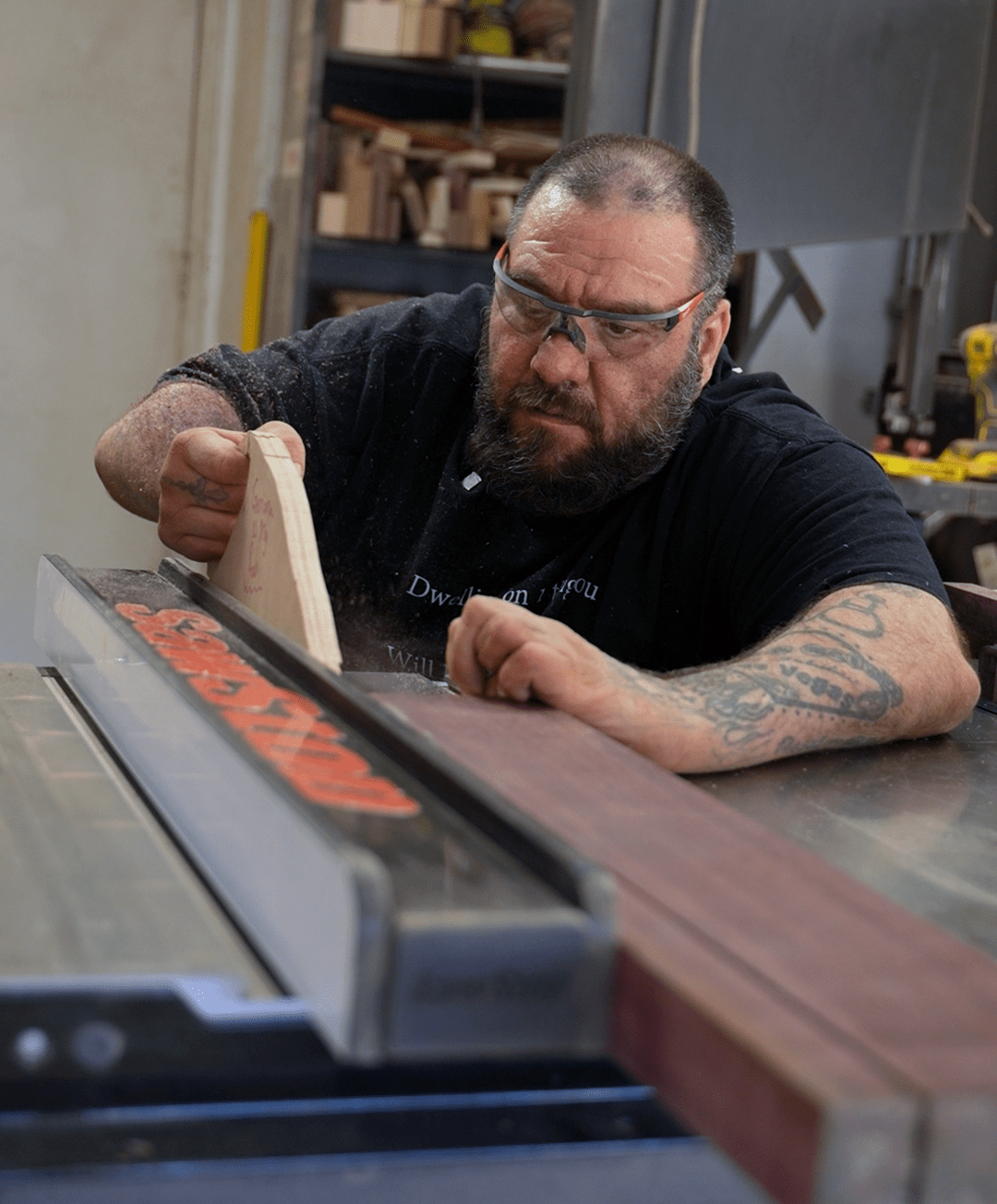
For the router, Russo takes 10 light passes, while another woodworker might take two.
“Instead of making it two passes, I make 10 passes so it is not jerky on my hands,” he says, adding that the technique also produces cleaner cuts with fewer burn marks. He now shares this method regularly in online woodworking groups, and able-bodied woodworkers have adopted it for the same reason.
Even picking up lumber off the floor required problem-solving. Early on, Russo would loop a rope around a board to drag it up onto his lap. Now, he stacks wood against the wall so he never has to deal with it from the ground.
Russo credits his SawStop table saw and dust collection system as two of the biggest upgrades to his shop. The dust collector in particular changed how he moves around the garage — without it, pushing through a cloud of sawdust in a wheelchair at the end of a long session was its own obstacle.
“It was like pushing through a pillow,” he says.
The Work and the Vision
Russo’s signature pieces are his end-grain cutting boards, some of which involve as many as 12 separate glue-up sessions. His Burberry plaid pattern board is among the most complex — seven initial glue-ups, then five more after cuts are made and pieces are rearranged. The first one came together perfectly. The next two were failures. He spent two years trying to figure out what was going wrong, until one afternoon, while sanding, the answer simply came to him.
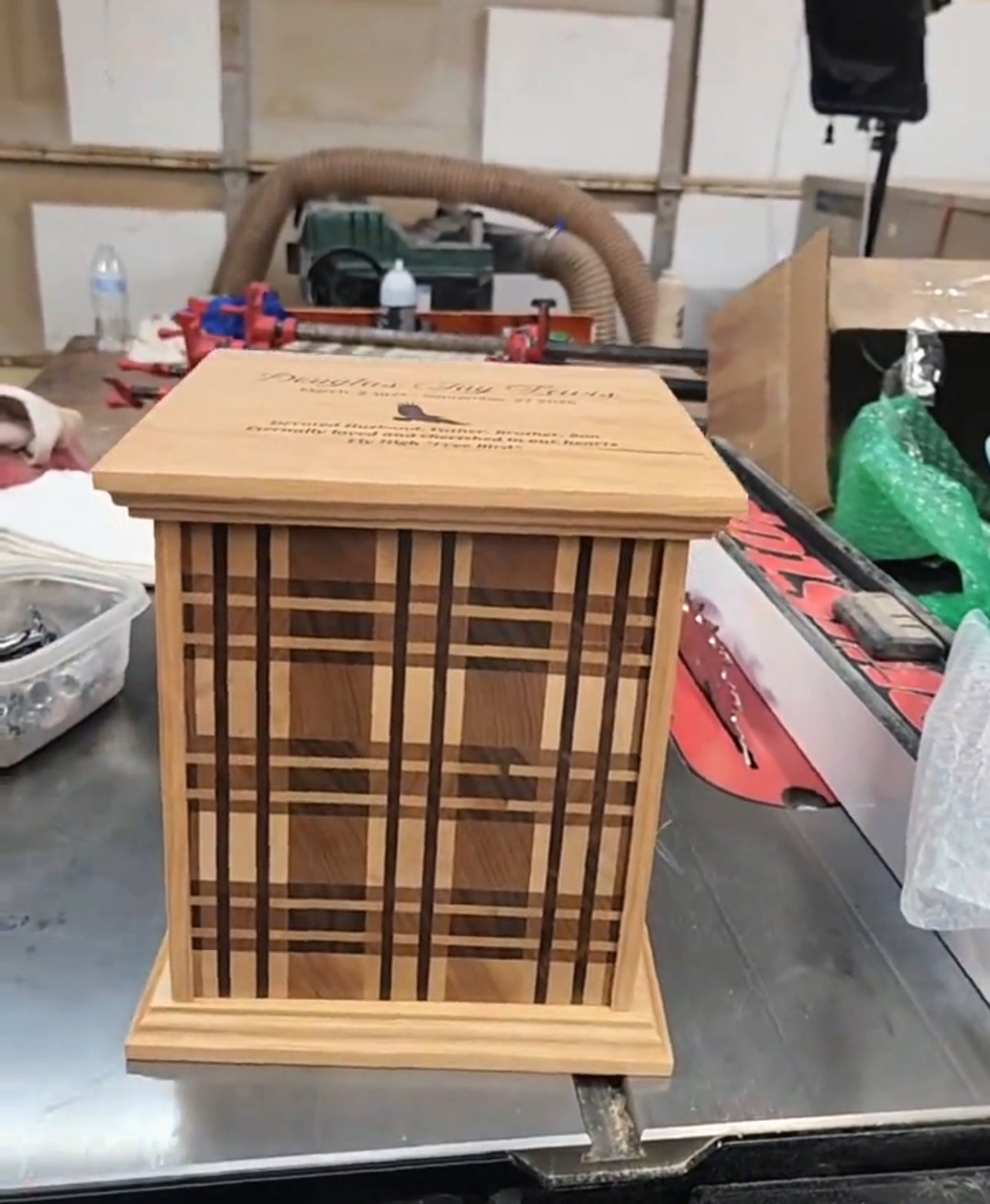
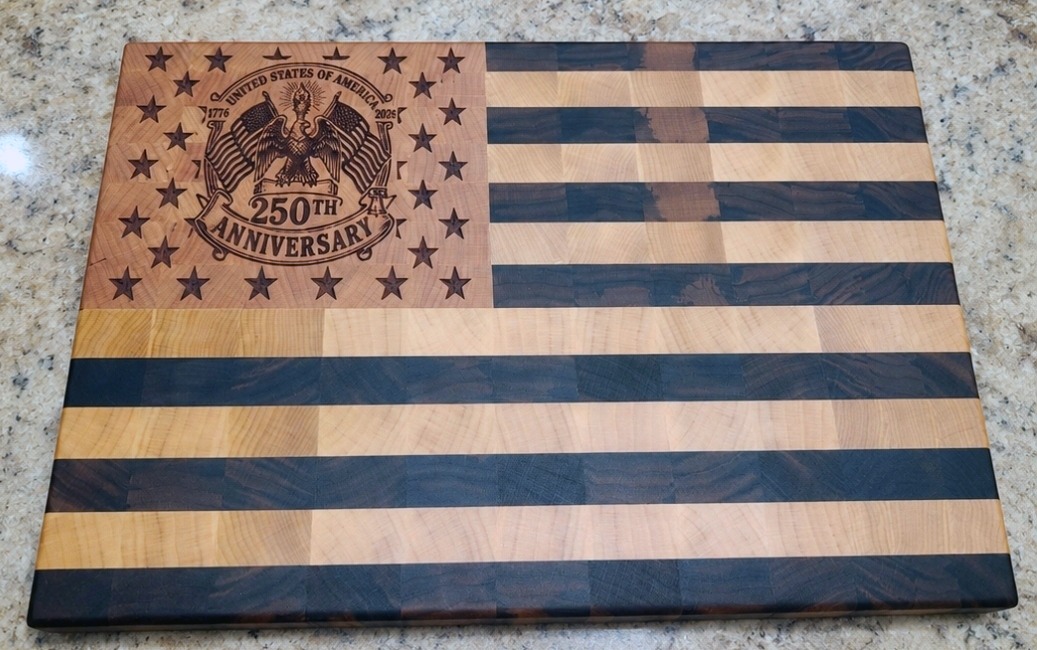
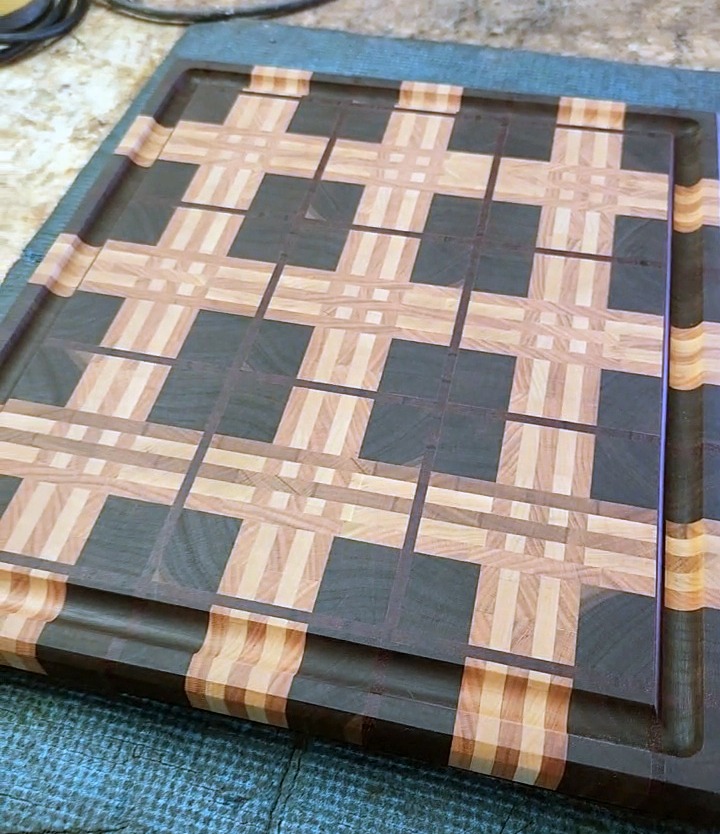
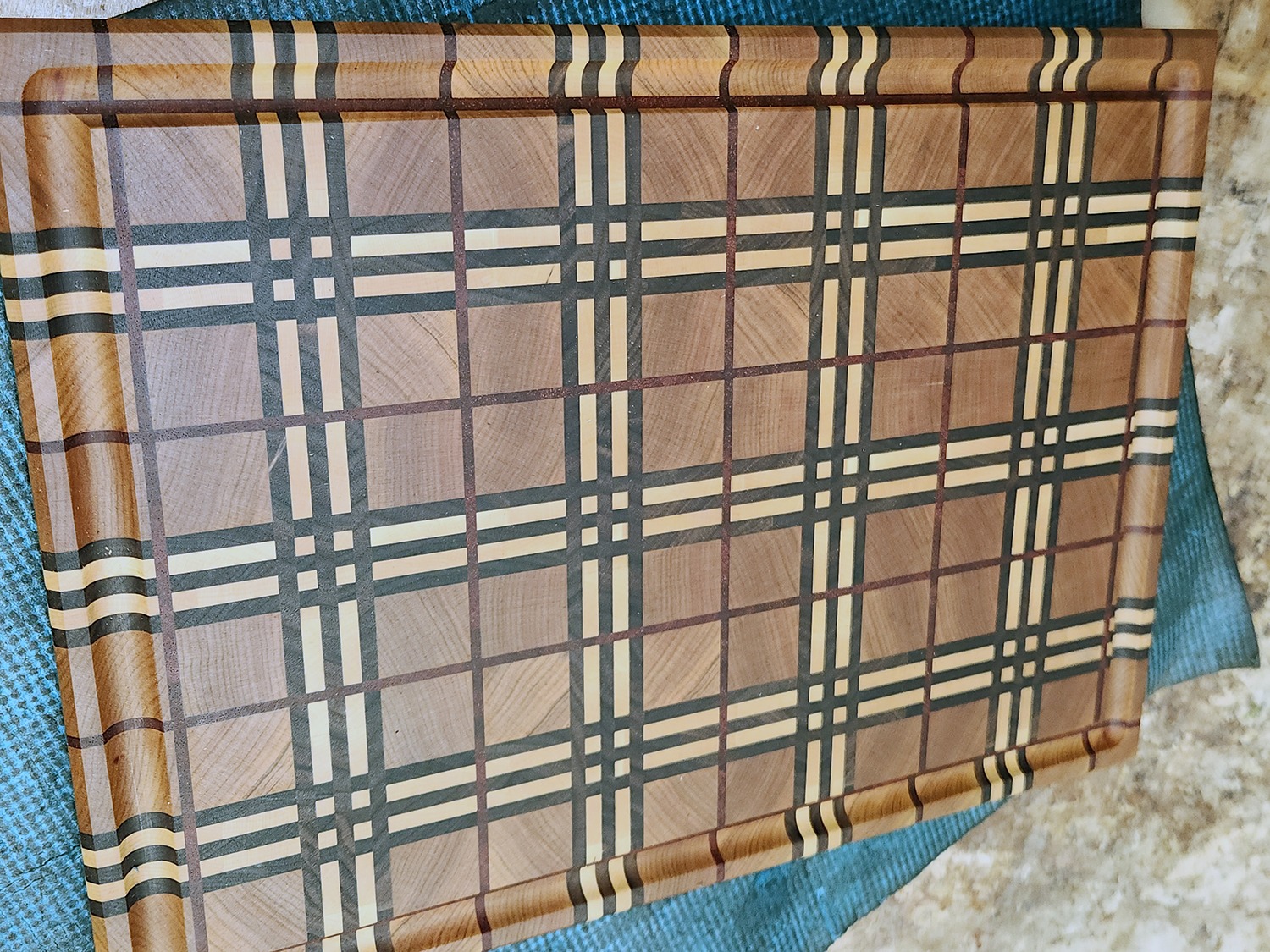
“One day I was out there sanding and it popped in my mind,” Russo says. “Now, it is perfect every single time.”
That board generated 5.5 million views on Instagram and kept him buried in cutting board orders for seven straight months.
More recently, Russo has added laser engraving to his work, using both a 15-watt and a 45-watt diode laser to personalize pieces for weddings, Realtors and memorial urns. The urns have become some of his most meaningful work — and some of the hardest.
He made the first one for Tara, the mother of his daughter, who died in 2021. Russo is proud of the craft that goes into each urn. But the conversations that surround them are another matter.
“I love getting the thank you,” Russo says. “But when you are talking to someone about the custom design and they start crying with you on the phone — it is a little difficult. The first urn I ever made was for my daughter’s mother. That was one of the hardest ones, ever.”
His 14-year-old daughter, Geriana, has been a fixture in the shop since she was 7. Over the years, she has quietly learned to operate every tool in the space, and last year she started using the table saw. She is quick to remind her father that woodworking is his thing, not hers — but she shows up anyway.
“She always lets me know woodworking is not her thing,” Russo says. “But she helps me.”
Looking ahead, Russo wants to move toward content creation, spending less time on bulk orders and more time on creative builds. He has been eyeing Japanese joinery and fine furniture-making as his next challenge, and he recently received a full set of Japanese hand saws to start practicing.
Inspiring Others, on His Own Terms
Russo’s message to others with high-level spinal cord injuries is printed right there on his shirt.
“Dwelling on one thing you can’t do will blind you from a hundred things you can do,” he says. “Usually when you get out of the dwelling mode and stop worrying about that one thing — you have already done it and did not even realize it.”
The message has traveled well beyond the woodworking world. Fans have sent him tools out of nowhere — roughly $10,000 worth over the years. A follower who had nothing to do with woodworking told Russo his story pushed him to pick up music again and sent along a recording of an original song. Customers have paid more for international shipping than for the cutting board itself, saying they just wanted a piece of his work to keep them motivated.
“When you have a passion and a purpose connected to it, it gives you the motivation to keep on doing it,” Russo says.
You can follow Pat Russo’s journey on Instagram and YouTube at Keep It Pushin Woodwork, and his website, keepitpushinwoodwork.com.