

Nobody gets to the starting line alone. Not in sports. Not in life.
Wheelchair athletes know this better than most. We know what it means to adapt when life changes overnight, to rebuild strength after losing something we once took for granted.
We know the hours nobody sees — the training, the setbacks, the equipment failures, the pain, the constant problem-solving just to stay competitive.
And we learn fast that independence is never really independence. Behind every athlete is a team, family, friends, coaches, trainers, teammates, caregivers, mentors — people who push you, steady you and sometimes carry you until you can push yourself again.

That’s true in sports. It’s true in military service, too. And it’s why a single afternoon with former MLB player Ted Williams has stayed with me for more than 20 years.
Back in 2000, I was honored by the San Diego Hall of Champions for my athletic achievements and contributions to adaptive sports. Before the ceremony, I joined fellow honorees, including baseball legend Rollie Fingers and legendary triathlete Paula
Newby-Fraser for a press conference.
About halfway through, the atmosphere changed. Conversations fell silent. Heads turned toward the entrance.
Ted Williams had arrived.
He wasn’t being honored that night.
His Hall of Champions recognition had come decades earlier in 1954. But Ted Williams was Ted Williams, and he had no interest in slipping into a room unnoticed. He burst in with the presence people expected of him, pointed across the room and announced, “Put me next to the squid!”
The room exploded with laughter. Ted was a Marine Corps legend. I’d served in the Navy. It was classic interservice rivalry, delivered with perfect timing. Naturally, he got his wish, and they rolled his wheelchair over beside mine.
For San Diego, Ted wasn’t just a baseball icon. He was one of ours — long before becoming known as the “Splendid Splinter,” he was a skinny local kid chasing a dream on neighborhood fields. By 2000, he was in poor health and using a wheelchair, too — not from paralysis like me but from strokes and heart trouble. Still, the moment he entered a room, people noticed. Some people never lose that presence.
A few minutes after he settled in beside me, I overheard him tell someone he wanted to sit next to “the other veteran.” That meant something coming from Ted.
Most people remember him for baseball — the last man to hit over .400, the home runs, the swing. But what always impressed me most wasn’t what he did on the field. It was what he walked away from.
At the height of his career, Ted left baseball to fly for the Marine Corps in World War II. He came back, rebuilt his career and left again to fly combat missions in Korea alongside another Marine aviator named John Glenn.
Ted gave up years of his athletic prime — years that would have meant more records, more money, more fame — because he believed serving his country mattered more than protecting his celebrity. America had given a poor kid from San Diego an opportunity, and when the country called, he answered. Twice.
Athletes understand sacrifice in a way many people don’t fully see. Teams train together, struggle together, sacrifice together. They trust each other under pressure. That bond, forged through shared hardship, is hard to explain to anyone who hasn’t lived it.
Ted understood all of it — pressure at the highest level, competition and combat, sacrifice, service to something bigger than himself. So, when he insisted on sitting beside “the squid,” and later called me “the other veteran,” I understood there was more behind the joke. Beneath the Marine swagger and the baseball legend was genuine respect — veteran to veteran.
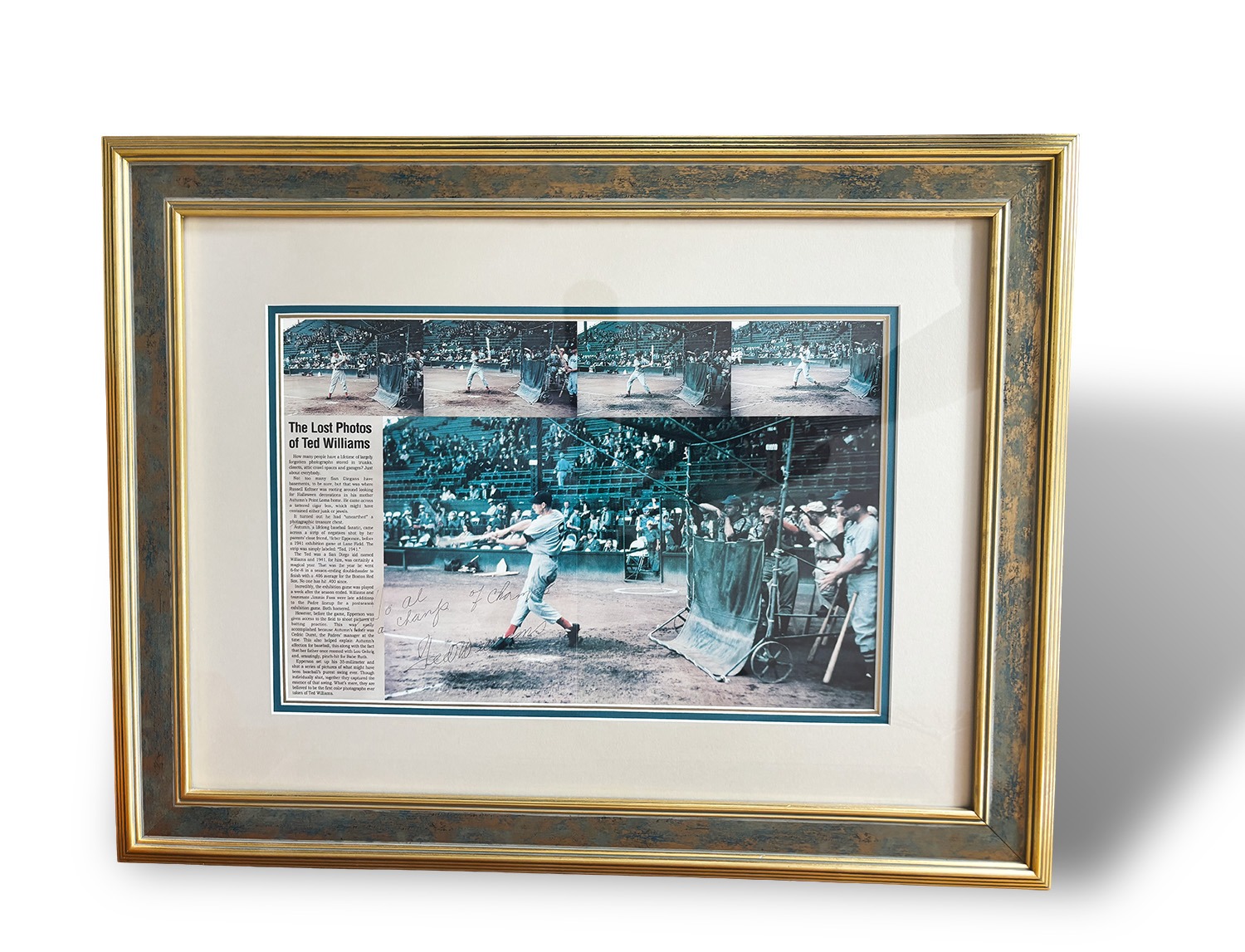
During the press conference, while I was answering a reporter’s question, I noticed Ted quietly pick up my copy of the event program. He opened it to the centerfold — a full-page photo of him frozen mid-swing — looked at it, closed it and set it back down without a word.
After the ceremony, the crowd rushed the stage. Everyone wanted a moment with Ted. I asked if he’d sign a baseball for me. Before he could answer, his handler stepped in, saying, “Mr. Williams doesn’t sign those anymore.”
I was disappointed for about two seconds — until another ballplayer, legend Tony Gwynn, who was standing
beside us, reached over, took the ball from my hand and signed it himself. Pure Tony Gwynn.
Ted Williams died two years later in 2002. Life moved on.
About 10 years after that ceremony, I was rummaging through an old desk drawer when I came across the Hall of Champions program. As I flipped through its pages, lost in memories of the event, I reached the centerfold and made an unexpected discovery. Scrawled across the photograph of Ted at the plate were the words:
“To Al, a champ of champs. Ted Williams.”
I just sat there staring at it. While I’d been answering questions, Ted had signed it for me without saying a word — and later, when I asked directly and was turned down by his handler, he never mentioned that he’d already done it. It wasn’t a rushed signature for a fan in a crowd. It was quiet. Deliberate. One veteran honoring another in his own understated way.
It felt less like memorabilia and more like a message.
I had the photograph framed, but I didn’t hang it somewhere visitors would notice. It’s in the hallway leading to our bedroom — a place only my wife and I really see. That feels right, because it means far more than a sports autograph.
What Ted gave me that day had nothing to do with celebrity. It was respect — veteran to veteran, athlete to athlete, one person recognizing something familiar in another.
Every time I roll past that photograph, I think about more than baseball. I think about the people who carry sacrifice, loyalty and service with them long after the crowd disappears and the spotlight fades — the same people who show up for us long before we ever reach the starting line.
As always, please share your thoughts with me at al@pvamag.com.