


Wheelchair rugby comes to Armenia through kirigami-inspired engineering
By Rory A. Cooper, PhD, PLY; Marina Davtyan, MD; Ian Rice, PhD, PLY; Jessica Steinberg, MS; Garrett Grindle, PhD; Kaitlyn Thornton, OTD, OTR/L; Rosemarie Cooper, MPT, ATP; and Agustin Urioste, BS.
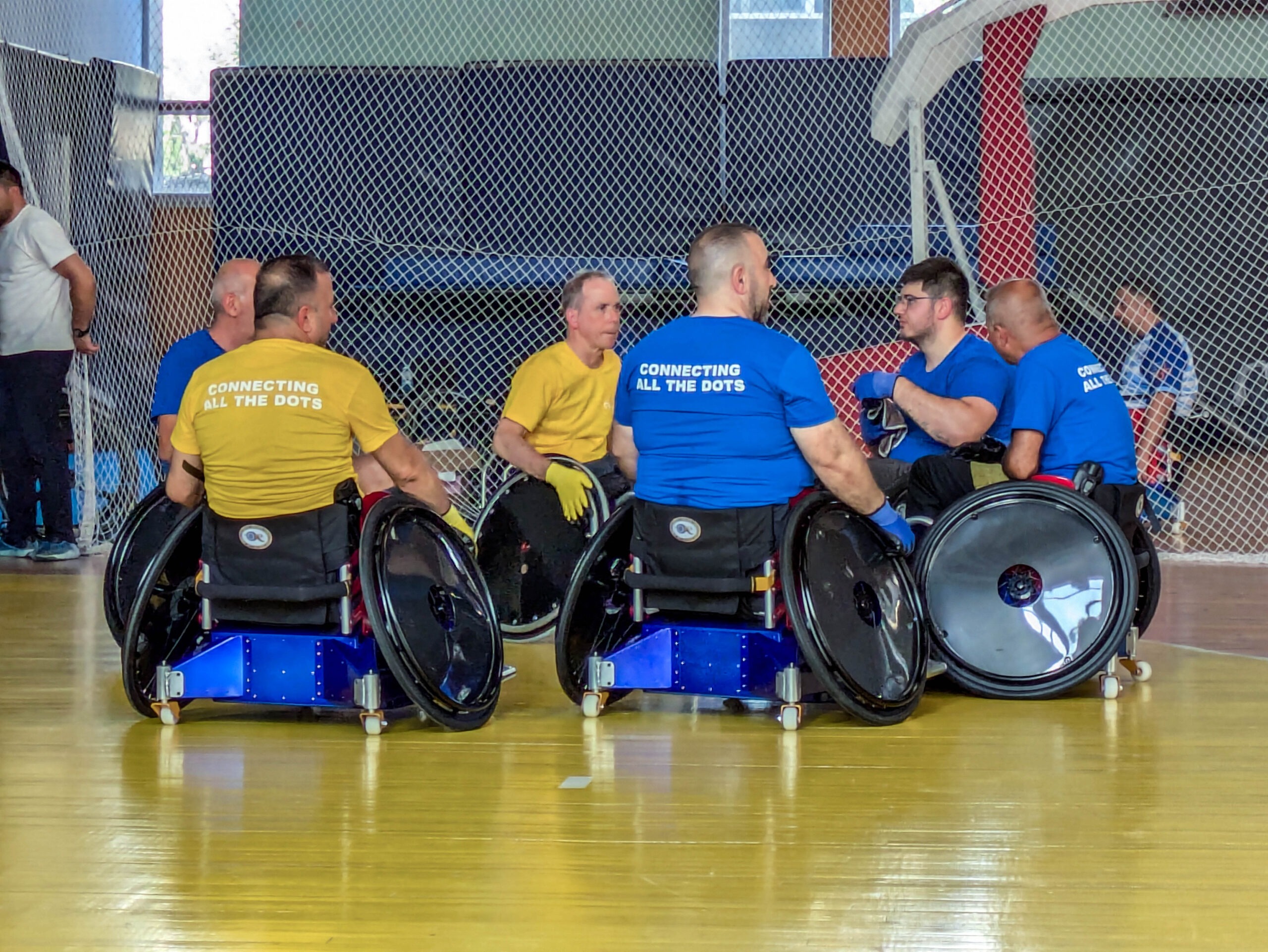
In mid-summer, on a court in Yerevan, Armenia, eight athletes who had never played wheelchair rugby took the floor in chairs that had not existed just two years earlier. Two teams of four squared off in the country’s first wheelchair rugby game, a milestone that was years in the making, built on an unlikely combination of international fellowship, cross-continental engineering and paper-folding.
This story begins not on a rugby court, but in laboratories in Pittsburgh.
Fellowship Plants A Seed
Marina Davtyan, MD, an entrepreneur and innovator from Yerevan, arrived at the University of Pittsburgh’s Human Engineering Research Laboratories (HERL) as a fellow of the U.S. Department of State’s Young Transatlantic Innovation Leaders Initiative (YTILI). The program brings early-career innovators from Europe and Eurasia to the United States for hands-on placements with American companies, universities and research institutions, pairing them with mentors who work in their field of interest.
At HERL, Davtyan worked alongside Rory A. Cooper, PhD, the lab’s founding director, and his colleagues, who have spent decades developing technology to expand independence and athletic opportunity for wheelchair users. Davtyan’s own venture, Connectra, focuses on using real-world data to improve care and outcomes for people who use prosthetics and wheelchairs, which created a natural fit for HERL, whose researchers have long focused on building lightweight, highly customizable and affordable wheelchairs.
The fellowship experience did what it is designed to do: It did not end when Davtyan returned home. Instead, it became the seed for a joint venture. Davtyan and Cooper applied for and received a YTILI reciprocal exchange project, a mechanism built specifically to send American mentors abroad to continue collaborations started during the fellowship. Their proposal was to bring wheelchair rugby, and the technology to play it, to Armenia for the first time.
An Old Art Solves New Problem
The chairs at the center of the project trace back to an idea rooted not in mechanical engineering textbooks, but in an ancient Japanese paper craft.
Kirigami, a variation on origami that adds cutting to folding, allows a single flat sheet of material to be transformed into complex 3D shapes. HERL researchers applied that principle to wheelchair design, building a customizable frame that can be cut and formed from sheet aluminum rather than the bent and welded tubing used in most wheelchairs.
The approach was never just an engineering curiosity. HERL engineer Jessica Steinberg, MS, who designed the kirigami rugby wheelchair, has pointed to the tens of millions of people worldwide who lack access to an appropriate wheelchair as the motivation behind the work. Sheet-metal fabrication is a manufacturing process available in nearly every country, which means a kirigami-style chair does not require the specialized tube-bending and welding infrastructure that traditional wheelchair frames demand. This provides a critical advantage for building sports equipment capacity in a country without an existing wheelchair rugby supply chain.
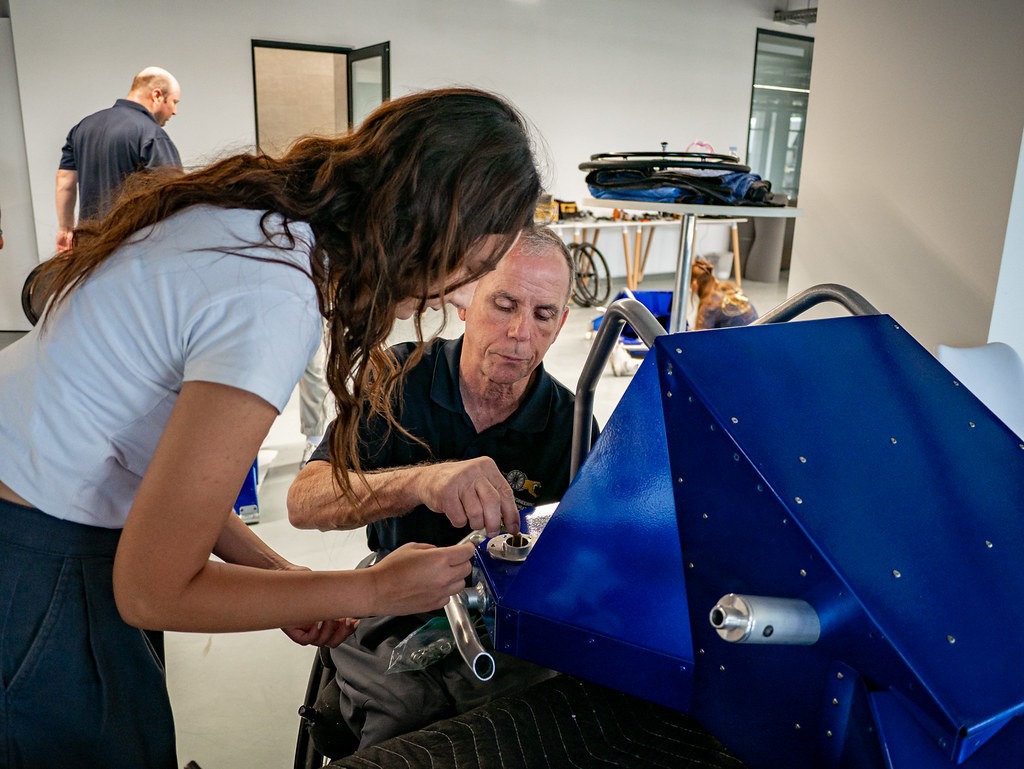
assembly of kirigami wheelchair rugby chairs in Armenia. (Photos courtesy of HERL Staff).
The kirigami-engineered wheelchair concept began as a design process supported by the U.S. Department of Veterans Affairs and aimed at improving mobility devices for veterans. It was later expanded specifically toward adaptive sports equipment, including tennis, basketball and rugby wheelchairs, through funding from the National Institute on Disability, Independent Living and Rehabilitation Research under a Rehabilitation Engineering Research Center (RERC) grant called Power of Play, co-led by Ian Rice, PhD, of the University of Illinois at Urbana-Champaign and Cooper at the University of Pittsburgh. That project’s aims specifically include designing and fabricating rugby wheelchairs using kirigami methods and validating those designs against wheelchair standards. High-end rugby wheelchairs typically cost thousands of dollars, putting them out of reach for many athletes and programs around the world, which is precisely the gap the kirigami approach was engineered to close.
One Trip To Yerevan
With the YTILI reciprocal project funded, the work shifted from the lab to logistics. A HERL design and fabrication team led by Steinberg built 10 kirigami-inspired and engineered rugby wheelchairs and shipped them from Pittsburgh to Yerevan. This equipment helped make a new sport possible in a country that had never had access to the specialized chairs required to play it.
Cooper then led a delegation from the University of Pittsburgh and the University of Illinois to Armenia, where Davtyan hosted them. The visit was built around several linked goals: strengthen the research relationship between Armenia and the United States, finish assembling and fitting the wheelchairs with input from Armenian partners and put the equipment into the hands of players and coaches for the first time.
Symposium To Scrimmage
Davtyan organized a scientific symposium and an entrepreneur and innovator meeting timed to the delegation’s visit. The symposium and meeting allowed for a rehabilitation research and development exchange between the two countries, bringing together clinicians, engineers and innovators from Armenia and the U.S. delegation to discuss adaptive technology, disability sports and product development.
The visit also served as a catalyst for institution-building. During the exchange, the Armenian Paralympic Committee, together with local adaptive sports leaders and Yerevan-area rugby clubs, formed and publicly announced a new organization: the Armenian Wheelchair Rugby Association. It was a deliberate piece of sequencing — the fabrication and delivery of equipment paired with the creation of a governing body to sustain the sport once the American delegation went home.
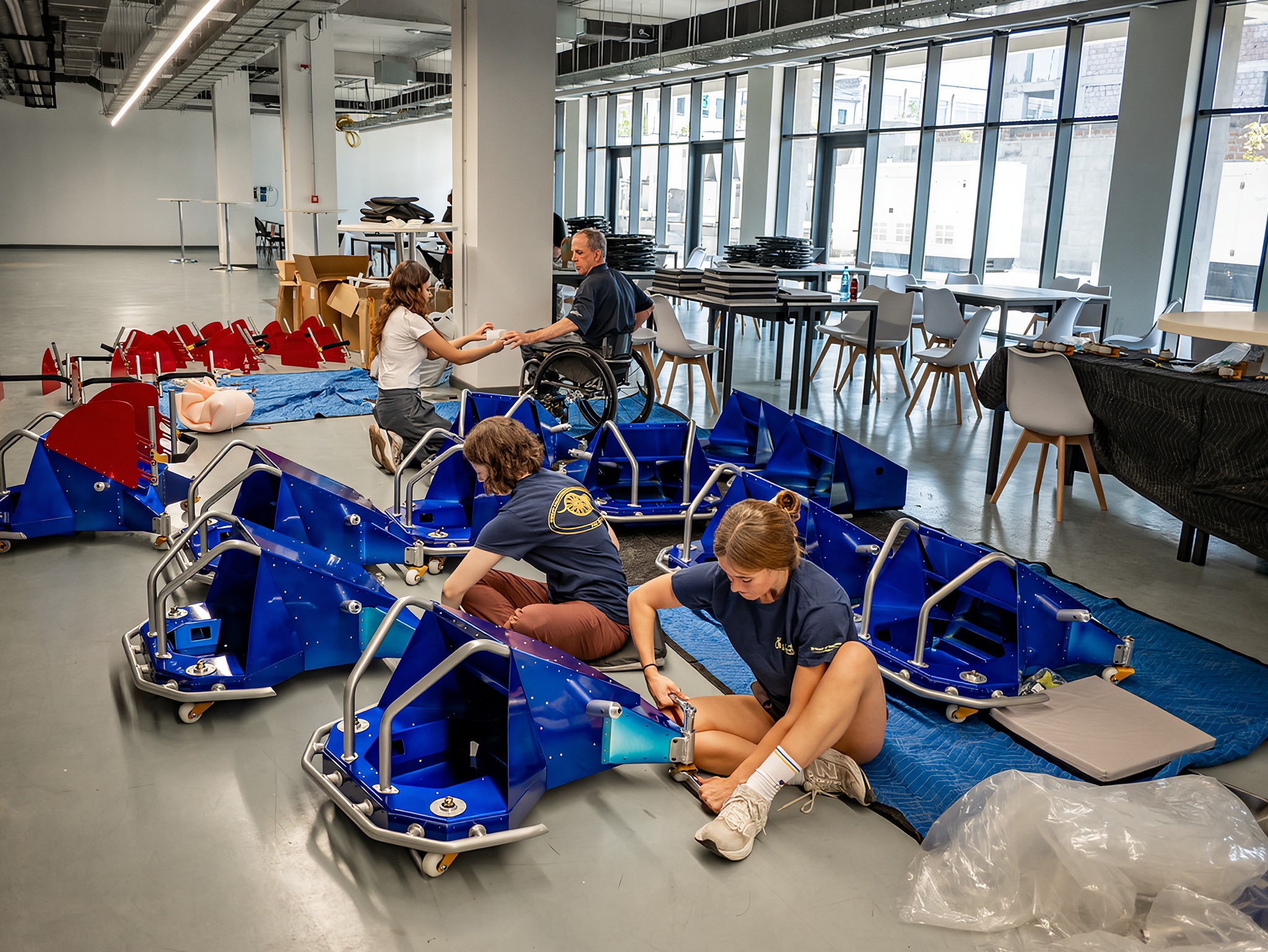
assembly of kirigami wheelchair rugby chairs in Armenia. (Photos courtesy of HERL Staff).
With the association in place, the visiting team completed final fabrication and fitting of the rugby chairs alongside their Armenian partners, then ran a wheelchair rugby workshop in cooperation with the new Armenian Wheelchair Rugby Association and the Armenian Paralympic Committee. Eight players attended, along with coaches and people interested in learning to officiate the sport. This was the first cohort of what organizers hope will grow into a national program.
The workshop’s second day produced the moment the entire project had been built toward. Two teams of four players took the court for Armenia’s first organized wheelchair rugby game, played in chairs designed half a world away and finished by hand just hours earlier.
Building Sports On Data
True to Davtyan’s background, the game itself doubled as a research opportunity. Connectra collected activity data during play and instrumented the chairs during the session so Armenia’s wheelchair rugby program can be built on a scientific foundation from its very first game, rather than growing informally and only later trying to retrofit data collection and performance analysis onto an established program.
That instinct to treat a new sport’s launch as a chance to gather evidence rather than simply hold an event reflects the same thread running through the entire project. What started as one fellow’s placement in HERL became a wheelchair design innovation, a funded international collaboration, a shipment of custom equipment, a newly chartered national sports association and, finally, a scrimmage on a Yerevan court.
What Comes Next
The Armenian Wheelchair Rugby Association now has 10 kirigami-engineered chairs, a trained core of players and coaches and a data set from its first competitive session. The Power of Play RERC continues to refine the kirigami design and manufacturing process for adaptive sports equipment more broadly, with an eye toward making sport-specific chairs easier and more affordable to produce anywhere in the world, not just in Yerevan.
For Davtyan and Cooper, the project is a case study in what a single fellowship placement can generate when the relationship outlasts the program itself. A YTILI cohort built to connect innovators across the Atlantic turned into a pipeline for real equipment, a new athletic association and, for eight Armenian athletes, a first taste of a sport that, until this year, had never been played in their country.
The Free Spin is our bi-monthly gift to the adaptive sports community. Each month, we handpick one article straight from our latest issue and make it free for everyone — subscribers and non-subscribers alike. It’s our way of sharing the stories that matter most, with no barriers. For more articles like this, subscribe today!