

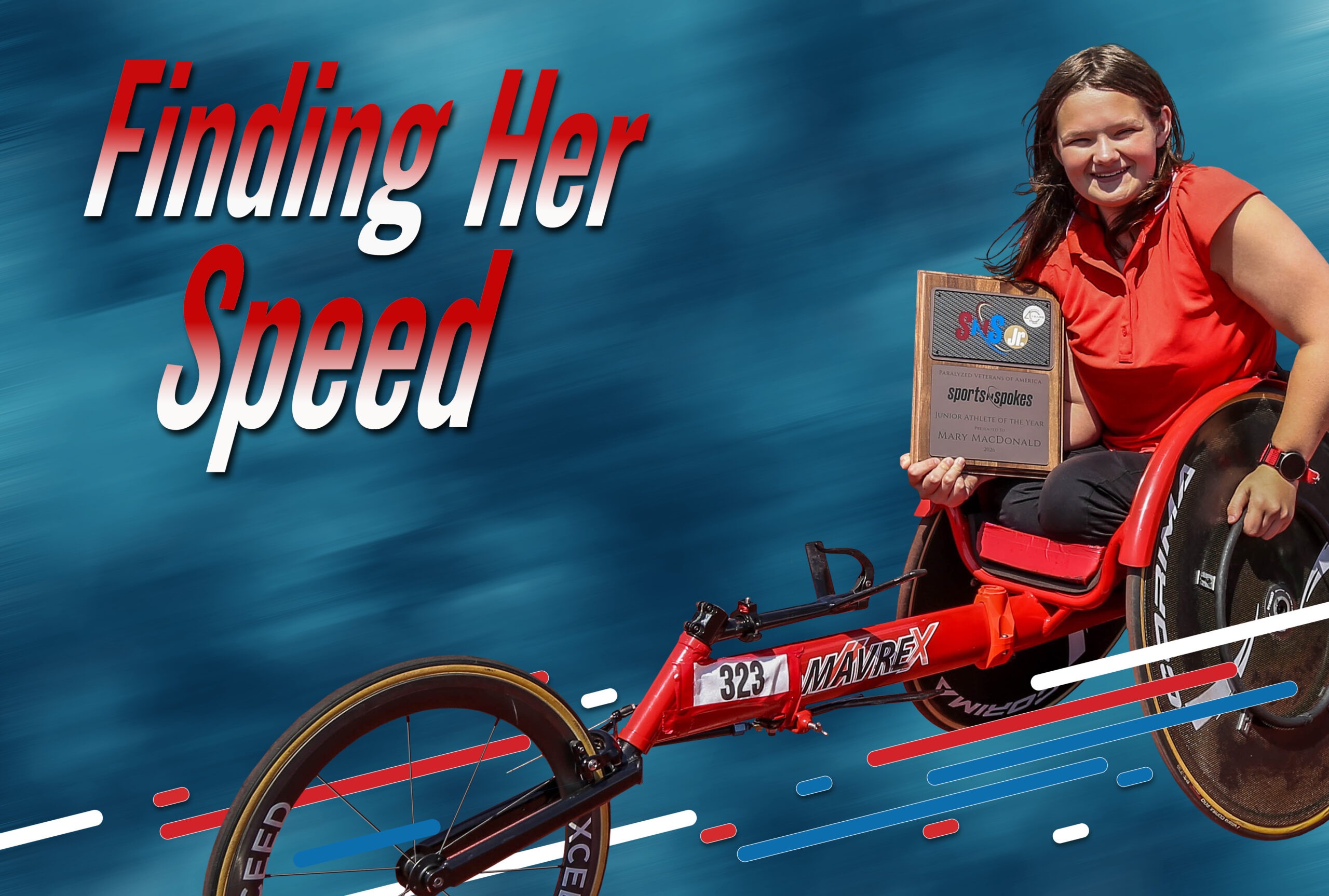
The alarm goes off at 4 a.m.
It’s still dark outside when Mary MacDonald rolls out of bed, gets dressed and heads out the door before most of the 17-year-old’s classmates have hit the snooze button once.
Four mornings a week, MacDonald makes her way to the track at Taunton High School in Taunton, Mass., because her own school, Bristol-Plymouth Regional Technical High School in Taunton, doesn’t have one of its own.
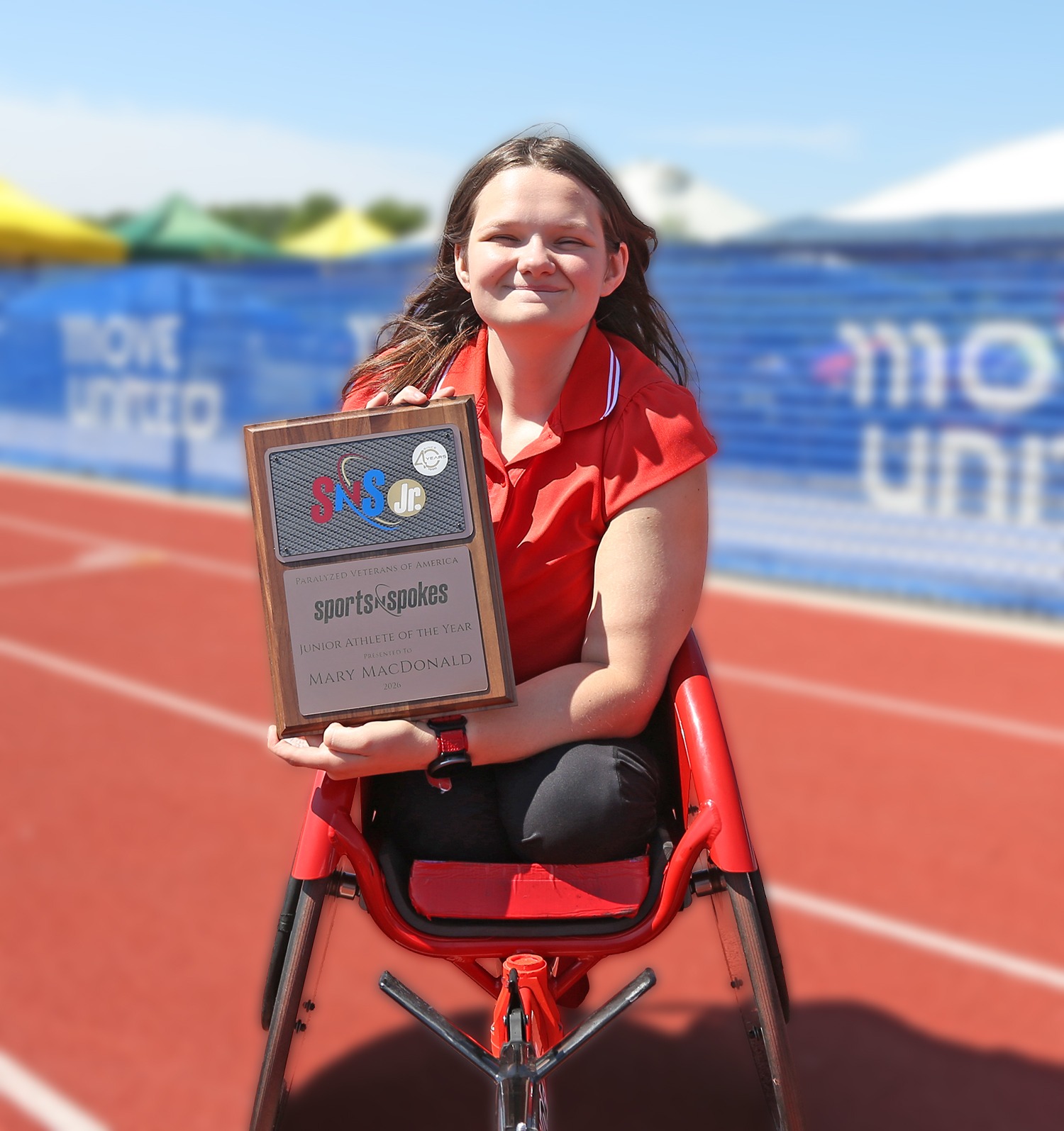
The early hour is by design; it’s the only time MacDonald can use Taunton’s track without interfering with that school’s own team.
That kind of quiet, unglamorous discipline is easy to miss in a highlight reel. It doesn’t show up in a statistics line. Still, it’s the clearest window into who MacDonald is, and it’s one of the reasons why Sports N Spokes named her its 2026 Junior Athlete of the Year, a milestone the magazine celebrates for the 40th time.
Where It Started
MacDonald, who has arthrogryposis multiplex congenita that affects joints in her lower body, competes in wheelchair racing, seated throws, para powerlifting and para triathlon.
She’s won a handful of events at the Tri-State Games in New Jersey and The Hartford Nationals across multiple disciplines in back-to-back years. MacDonald totaled seven gold medals at the 2024 The Hartford Nationals in Alabama, eight more at the 2025 event in Grand Rapids, Mich., and then exploded for another 11 at the 2026 event this past July in Grand Rapids.
She’s won gold medals in the girls’ 17-19 100-, 200-, 400-, and 800-meter races and shot put each of the past three years, discus, javelin and the 1,500 the past two years and also won gold and silver medals in para powerlifting and gold in para triathlon and aquathlon this year.
Additionally, MacDonald has recorded five junior records over the past three years, including two The Hartford Nationals 86-kilogram rookie records in para powerlifting in 2024, one Adaptive Track and Field USA record in the U17 F54 javelin (7.63 meters) in 2025 and two more The Hartford Nationals para powerlifting 55-kilogram rookie records this past July.
That level of success helps explain why she keeps returning to the track before sunrise.
But she offers another reason, too.
“I love just going fast,” MacDonald says of the sport that started it all. “It’s so freeing, you know? That’s why it’s so close to my heart, the freedom that you feel when you’re on a track.”
That freedom didn’t come easily or quickly. In 2020, she was struggling with her weight and with severe depression, something MacDonald speaks about candidly now. Her parents steered her toward wheelchair track, a sport she had seen before but never imagined she could excel in.
MacDonald started small in eighth grade, racing 100-meter sprints in a basketball chair rather than a racing chair. Later that year, she met Katrina Gerhard, a 2019 Los Angeles Marathon women’s wheelchair division winner who introduced MacDonald to her first true racing chair. Everything changed.
“At first, I did it just to lose weight and to feel a little bit better,” MacDonald says. “And then, you know, runner’s bug. So, I ended up just loving it in general.”
She says the same about lifting, which MacDonald first discovered through CrossFit, which taught her to love a challenge. Para triathlon came last, a natural blend of the swimming she already loved and the handcycling she does with equipment provided through a Challenged Athletes Foundation grant. Together, those sports broadened the training life that now fills her schedule.

Health Center in Taunton, Mass.— the first public community scale of its kind in that region of the state. (Photo courtesy of the MacDonald family).
Four years after that first 100-meter sprint in a borrowed basketball chair, MacDonald now trains nine to 12 sessions a week, by her own count, a workload she knows some might call overtraining.
“To me, I say it’s a schedule,” she says.
That schedule includes weekend road races to build experience, afternoon workouts with New York City Para Sports Academy and, of course, those early mornings on another school’s track. It has also produced results that reach beyond her own résumé.
MacDonald has broken barriers as the first female athlete to win multiple para events in her circuit. She doesn’t take that distinction lightly in a sport where, MacDonald estimates, only about a quarter of competitors are women, and where she’s currently one of only two girls competing at the high school level in her state. Those milestones lead directly into what they mean to her.
“It makes me wonder if there’s a kid out there watching what I’m doing currently and wanting to do what I started doing,” MacDonald says of being first. “To know that I might be able to be the next example for that in the future just makes me so proud and so happy.”
Beyond the Finish Line
MacDonald’s ambitions extend well past the finish line.
Her Girl Scout Gold Award project grew out of a moment at a doctor’s office, when she realized there was no accessible scale for a wheelchair user like herself. MacDonald recalls being lifted onto a scale by her parents, a routine that took a physical toll on them as they got older and that, she says, costs patients like her their dignity.
MacDonald’s now working to bring seated scales to more clinics in her area so wheelchair users can be weighed with more dignity and less physical strain. She has hosted a series of advocacy Zoom webinars, including one with Paralympic wheelchair marathoner Susannah Scaroni, and has another planned around mental health resources, a subject close to her after her own experience in therapy. That work widens the lens on how she defines advocacy.
“Health and wellness is a very hard thing to have accessible, because people think, ‘Oh, all we need is a ramp to be OK,’” MacDonald says. “But to be honest, that’s not it. We need the same exact health care that anyone else would need. But it might look different. We still need it.”
Her advocacy work also extends to poverty and social justice through her role as a Project 351 ambassador. Both are causes MacDonald says trace back to her own childhood in a mobile home park when her mother relied on food stamps to get by.
She has also built a sizable social media following documenting her life as a teen athlete with a disability, which MacDonald says started as an impulse one afternoon while scrolling through her phone and has since become an unexpected source
of connection.
“I never thought I’d be like that connector, that glue, to get people into sports more,” she says. “People are just able to reach out if they want to, and they can look at my content and go, ‘OK, I can actually talk to this person.’ And that’s what I want.”
Carrying a Legacy
Woven through it all is the influence of Bob Hall, the wheelchair racing pioneer who essentially created the sport’s marathon division and died earlier this year.
MacDonald never met him, but she ran her first Falmouth Road Race in Massachusetts during its 50th anniversary and finished sixth despite her chair’s water system breaking before the start, leaving her without water for all 7 miles of hills. Hall’s legacy adds meaning to her racing memories.
“That’s the good thing about racing,” she says. “You always come out with a good story.”
At a vendor fair in Taunton, MacDonald met one of Hall’s longtime friends, who stopped by her booth and shared stories about the man MacDonald calls one of her biggest inspirations, despite never speaking with him directly.
“It was really cool to meet someone who knew him because I didn’t get to meet him,” she says. “But knowing that I got to learn about him through someone who knows him was great.”
Family Ties
Home for MacDonald is a blended family she describes fondly as something like the movie The Parent Trap.
Her mother and stepfather met after MacDonald and her now-stepsister became friends in daycare, without either girl realizing their parents would later fall in love. That family connection carries into the support system around her training and advocacy.
MacDonald’s stepfather, Leif Glass, has also become her coach, gathering advice from her various trainers, consolidating it and shadowing her at road races to keep her safe from traffic.
“I want to thank my dad for doing that,” she says. “And I want to thank my mom for helping me with all my advocacy work.”
Looking Ahead
MacDonald is already weighing colleges, with Michigan, Alabama, Arizona and Illinois currently in her top four.
She hopes to study public policy, disability studies and biology. Looking ahead, MacDonald sees those choices as part of the same path.
Athletically, she has her sights set on the 2032 Summer Paralympic Games in Brisbane, Australia. MacDonald points to wheelchair racers such as Tatyana McFadden, who’s still competing in her 40s, as proof that her career has a far longer runway than most able-bodied athletes, who often retire from racing by their late 20s.
“I think people don’t realize that,” MacDonald says. “I’m very lucky that I have a lot of time left.”
That long view extends to how she thinks about the next generation coming up behind her. Asked what she would tell a kid newly diagnosed with a disability who feels an athletic dream slipping out of reach, MacDonald didn’t hesitate. Her advice comes down to finding a personal reason to show up — what she calls a “why.” That mindset shapes how she sees recognition now.
“I want people to find their why,” she says. “Once you find your drive and what makes you move, you’ll be able to just continue to be the best you can be. Just find your reason to get out there, go do it and attack it head-on. It doesn’t matter what disability you have; you can do it.”
The Recognition
When she learned she had won Junior Athlete of the Year, MacDonald was left speechless, a rare state for someone so comfortable in front of a camera. Knowing it was the award’s 40th year only deepened the shock.
“I never thought I would be getting to this stage of my life where I’d be able to actually reach this standard,” MacDonald says. “I feel like one of the luckiest kids in the world.”
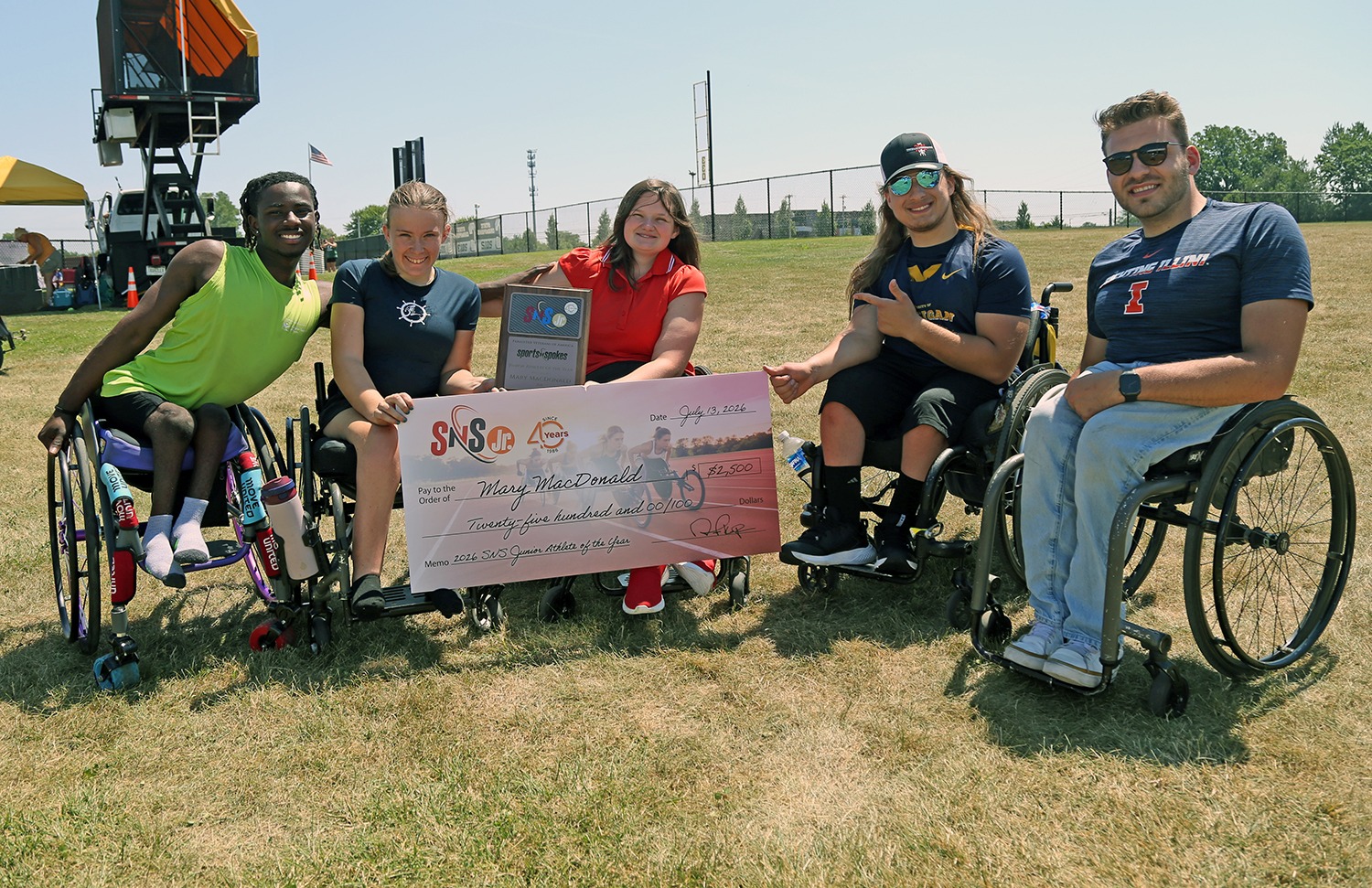
She was quick to credit the people around her, thanking her mother and stepfather, her coaches, the friends she’s made throughout the wheelchair racing community and her stepsister, whom she calls her twin.
Along with the recognition, MacDonald’s award includes $2,500 in cash, a custom-made trophy, a Sports N Spokes swag bag and a feature story and cover appearance in the magazine’s September issue.
For now, though, the mornings still start the same way they always have. The alarm goes off at 4 a.m. The house is quiet. The track belongs to someone else, at least on paper.
MacDonald gets up anyway, gets in her chair and goes, the same way she has for four years and the same way she plans to for years still to come.
It isn’t glamorous, and it was never meant to be. It’s the quiet discipline underneath every title, every record and every door she hopes to open for the girls who come after her.
For more information on the Sports N Spokes Junior Athlete of the Year award, visit sportsnspokes.com/juniors.
The Free Spin is our bi-monthly gift to the adaptive sports community. Each month, we handpick one article straight from our latest issue and make it free for everyone — subscribers and non-subscribers alike. It’s our way of sharing the stories that matter most, with no barriers. For more articles like this, subscribe today!