

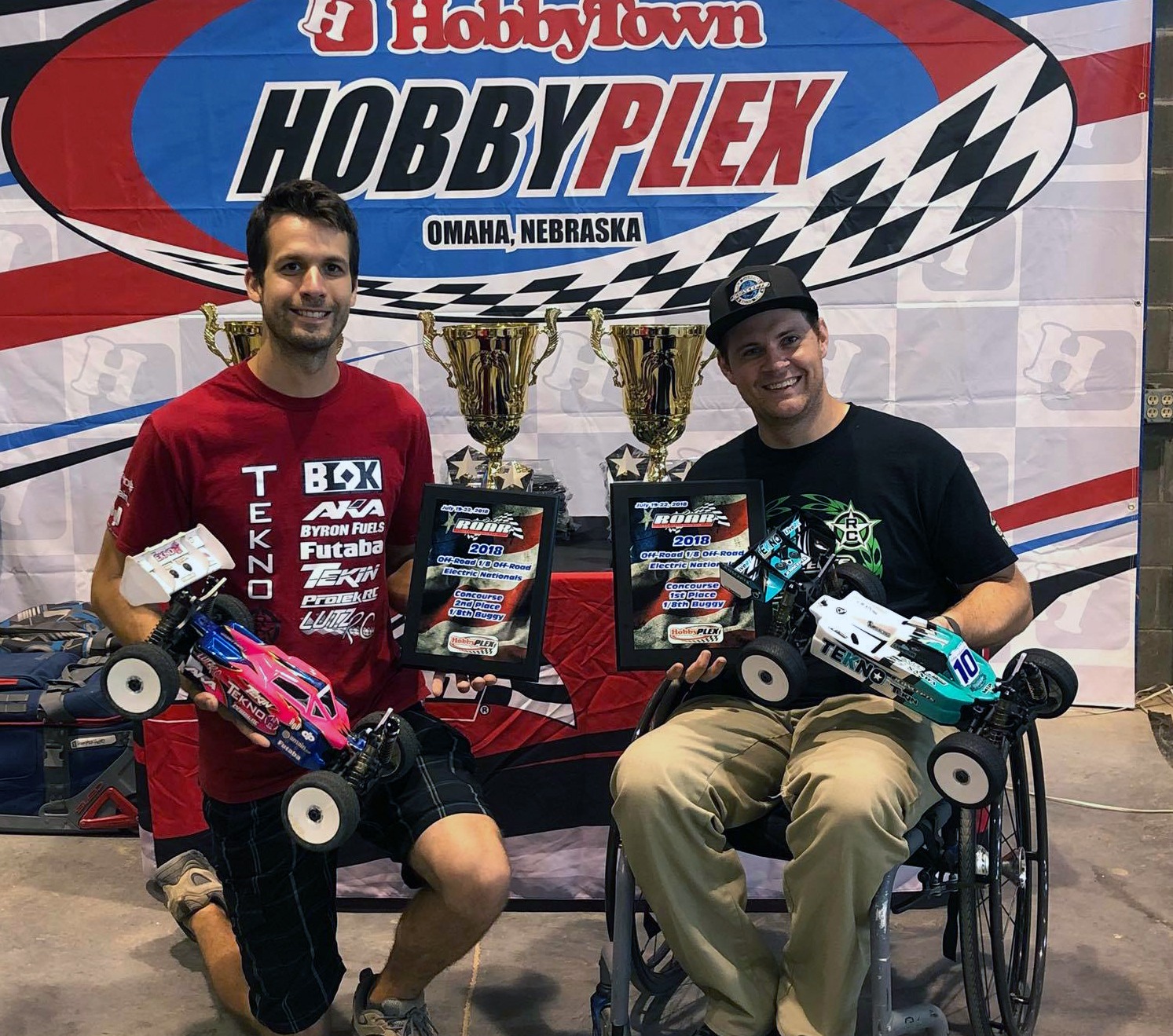
Paralyzed in a motocross racing accident at just 18 years old, Mike Garrison spent a few years searching for something that reignited his competitive edge.
Traditional wheelchair sports weren’t clicking. Adaptive motocross didn’t thrill him either.
Then, the Missouri resident remembered an old hobby he enjoyed with his dad — radio-controlled (RC) car racing.
From picking out and assembling the car to figuring out how to move a miniature motorized vehicle with a joystick and navigating obstacles and a track or course against a handful of other people to try to come out on top, his drive to win returned.
“It’s very, very similar to motocross. And it has that racing spirit and competitiveness to it,” says the 38-year-old Garrison. “ … After being paralyzed, I actually got back on a dirt bike and started racing motocross again using a dirt bike. It was all hand-controlled, specially built, and it gave me that thrill of being back on a dirt bike. But I always compare it to, it’s kind of like having a Corvette, but it’s got a governor on it that only does 25 [mph]. I was kind of limited on what I could do, obviously, you know, being strapped to the bike with only hand controls and things like that. Whereas when you go RC car racing, I can be just as competitive as the next guy — there’s nothing holding me back.”
Bringing It To The NVWG
National Veterans Wheelchair Games (NVWG) athletes will also have a chance to participate in RC car racing in an appropriate city for the sport, too.
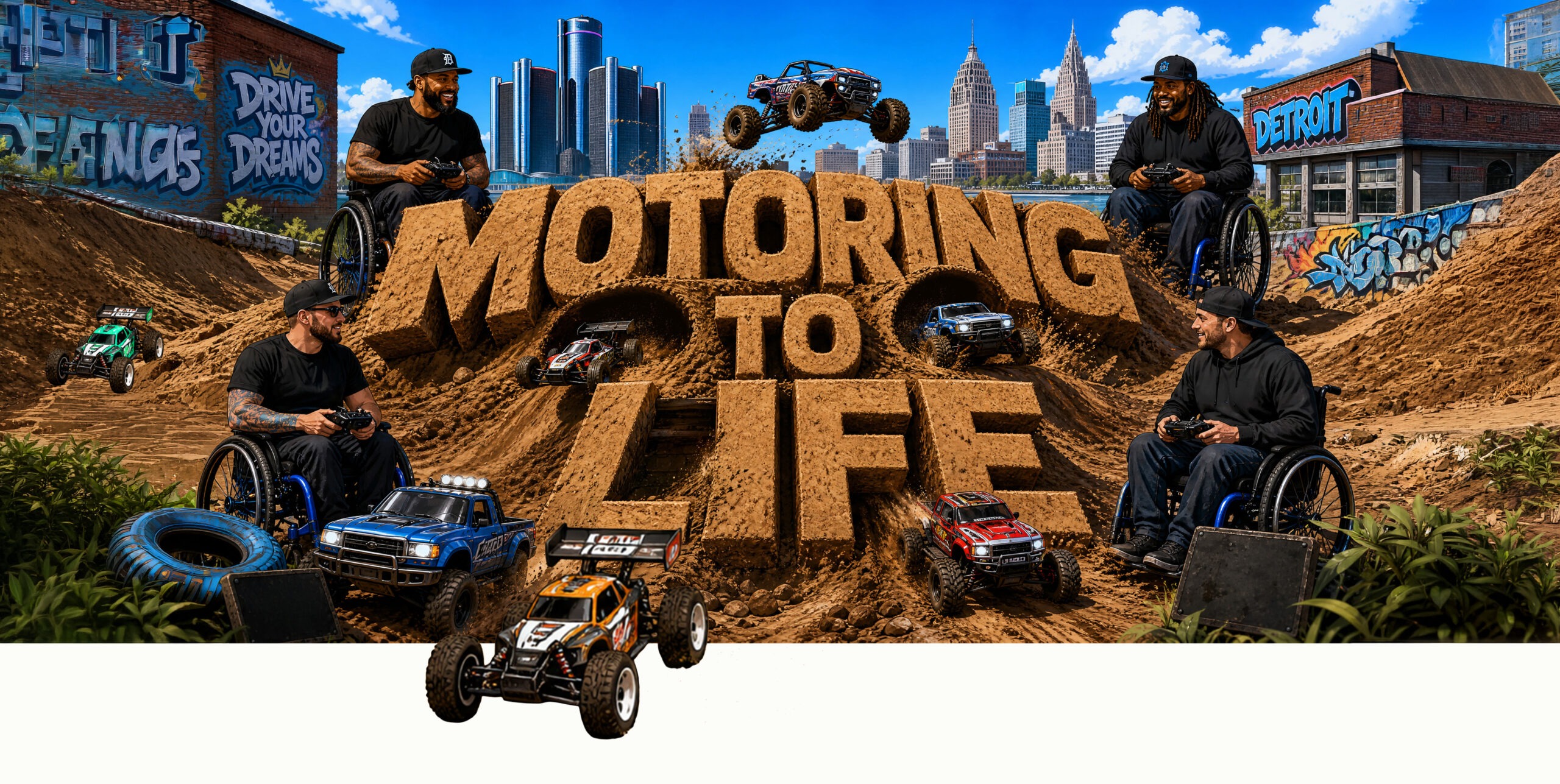
Adaptive RC car racing is part of this month’s NVWG in the “Motor Capital of the World” — Detroit. Cosponsored by Paralyzed Veterans of America (PVA) and the Department of Veterans Affairs, the Games are headed to “The Motor City” for the first time.
Detroit is where the U.S. automotive industry started its boom and is also the home of the Henry Ford Museum of American Innovation and IndyCar’s Chevrolet Detroit Grand Prix, which ran in May.
So, NVWG organizers have teamed up with Excel RC and Hobbies, based out of Garden City, Mich., to offer an adaptive RC car racing track tournament for 50 participants during the Games’ opening/expo day. NVWG co-director Jennifer Purser says RC car racing fit the Detroit-related themes of cars, gears and fast movement, so they decided to bring in the sport.
“I imagine it’ll be pretty cool, some sort of a cool [track] design that they’ll have,” Purser says.
There are a handful of different types of RC car racing, including off-road dirt track, road or asphalt, monster truck, rock crawler and regular drag racing. And there are plenty of groups that get together all over the United States to compete or just have fun.
As for the RC cars themselves, they can be purchased in hobby stores across the country — either pre-built or in build-it-yourself kit models. Vehicles are designed to be a fraction of the size they are in the real world. RC cars typically are 1:10 scale and are just over a foot to nearly 2 feet long. There are eight other scale sizes, too.
The bigger the size, the better they are for off-road racing, while the smaller sizes are more for indoor racing. Some can be more toy-like and fun, while others are for serious racers. Speeds can range anywhere from 10 mph to 30 mph for beginners to over 100 mph for advanced and heavily modified cars. And they’re controlled with just a throttle trigger and a small steering wheel.
Garrison likens it to playing a video game. And he definitely enjoys those.
Instead of having to push two joysticks and press buttons, racers instead use throttle and brake toggles or switches that speed the car up and slow it down, and then they turn the car’s wheels the direction they want to go with the small wheel. But for people with spinal cord injuries like quadriplegia or limited hand dexterity and other disabilities, that makes things more challenging. So, adaptations and modifications can easily be made.
“It’s really cool because I’ve seen a lot of different people adapt those in different ways, you know. I’ve had some friends that were quadriplegics that started racing RC cars, and they’ve adapted them to where, you know, they can use their chin to steer. I’ve seen everything from amputees use, you know, different setups for triggers and all that kind of stuff,” Garrison says. “And like I say, RC racing is really cool in that sense because with a little bit of customization and stuff, it seems like literally just about anyone on the planet can do it.”
PVA Involvement
That includes some PVA members, such as those involved with the PVA Cal-Diego Chapter in California.
According to volunteer and engineer Larry Houghton, the PVA Cal Diego Chapter started its adaptive RC club program about 10 years ago. Now, each month, the chapter holds a two-hour outdoor gathering at a large, grassy park at Nobel Athletic Fields And Recreation Center in San Diego, allowing members and hospital inpatients to race RC vehicles for fun.
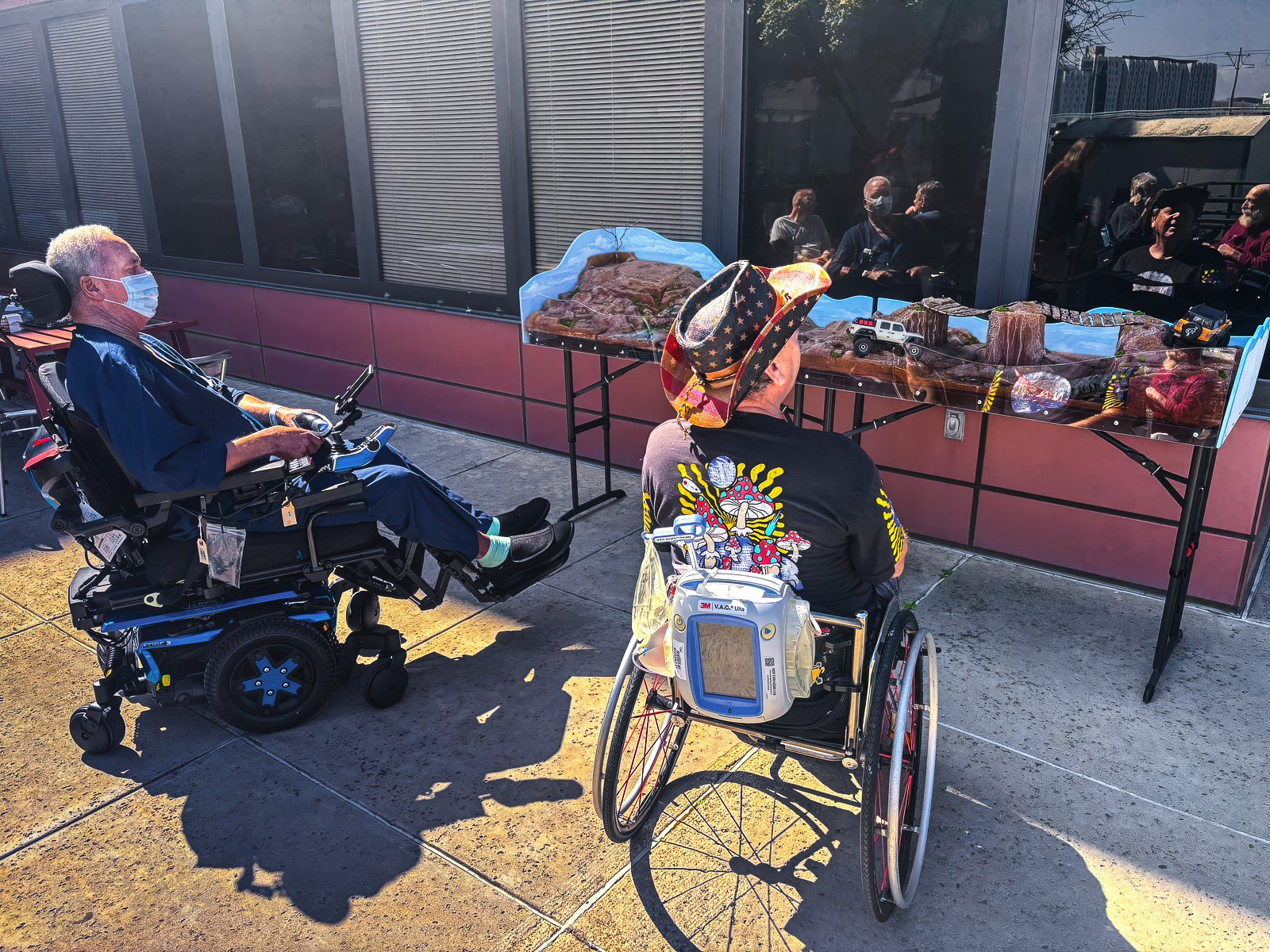
Additionally, the group built two rock crawler dioramas for inpatients to use as recreational opportunities at the Jennifer Moreno Department of Veterans Affairs Medical Center in San Diego.
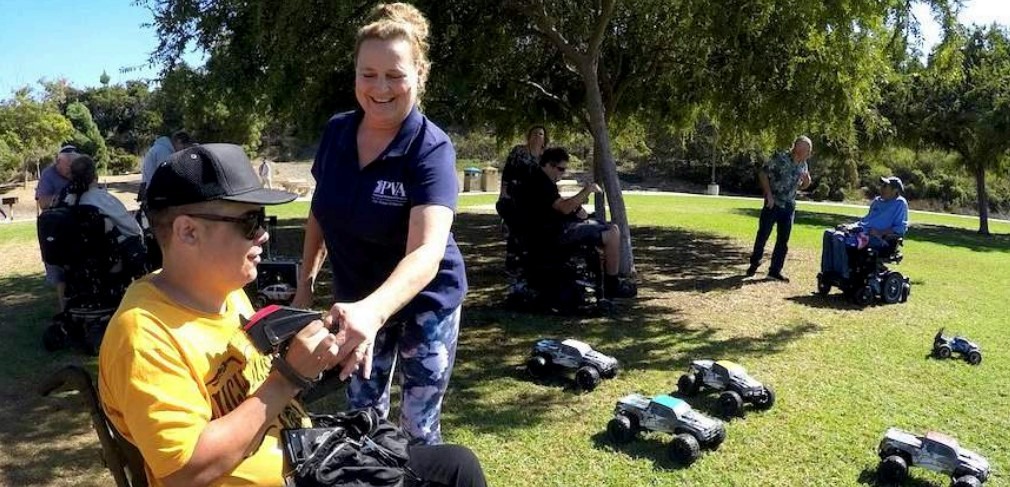
“While the program offers spinal cord injury patients a fun and challenging diversion, it also provides a bit of unstructured occupational therapy by practicing subtle motor skills used to control RC vehicles,” Houghton says via email. “The program is relatively low-cost and doesn’t require trained medical professionals. By using multiple sizes and types of RC vehicles, indoor and outdoor activities can be provided to most patients with the help of volunteers and enhances the healing process.”
Turning Things Around
They certainly helped Garrison heal. Growing up before his injury, Garrison didn’t do well playing traditional sports. He struck out plenty in T-ball and struggled with soccer, so his dad, Greg, suggested he try a new hobby — building and racing RC cars — with him. His first one was a 1:8 scale nitro-powered road buggy. Garrison and his dad each got one, built them together using little Allen wrenches, nut drivers, hex drivers and some other tools.
It was a bonding activity. He learned plenty of patience building them.
Later, he started racing motocross before being paralyzed during a 2006 motocross accident when he collided with another rider and sustained level T5-T6 spinal cord injuries, collapsed lungs and a shattered spine. Garrison never expected to return to RC car racing 20 years later.
But he remembered all those times with his dad. And he decided to go to a hobby store, buy one and try building and racing them again. Garrison, who has full use of his hands, could still set up his car and race without adaptations after his injury. When he first started racing, he was the only one at his local RC club in a wheelchair. Since then, he’s started to see much more participation.
“I encourage people ‘Don’t be afraid to ask questions,'” Garrison says. “And when you start out, you can get as involved and as deep in it as you want or as little as you want. And so, there’s some really good entry-level vehicles and races and race classes. And it kind of varies by location and by where you live and things like that. But, you know, start out with something simple, something easy, just to get your feet wet. Kind of get the hang of it and have fun, and then you can get more serious.”
This year, Garrison earned a major honor. In late-May, he was named to Team USA for the International Federation of Model Automobile Racing (IFMAR) ⅛ IC Off-Road World Championship Sept. 26 through Oct. 3 in Thornhill, Texas. It marks his second time being selected, after he was named to the 2008 U.S. team that competed in the IFMAR ⅛ Nitro Off-Road World Championships in Charlotte, N.C.
Now, his wife, Britani, participates, as do the couple’s twin 2½-year-old daughters, Teagan and Finley.
Garrison’s wife came from a racing family. They raced full-size cars, 4-wheelers and did drag racing, so it didn’t surprise him. Once again, it’s a time for family bonding.
“When I was 18, my goal was, you know, to be the very best racer that I could be and win races. That was all I cared about,” Mike says. “And now 20 years later, as a parent and being in it for so long, it kind of has a whole different meaning. And it’s kind of like almost like starting over again, you know? And it’s a refreshed, new version of RC racing for me because I think it’s really cool when you see families find something that they can all do together and all enjoy in a family-friendly environment. And that is what RC racing provides. And for anybody, you know, somewhere that we can go, we can all have fun, still be competitive, still chase the wins and things like that. But at the end of the day, the most important thing is we’re there as a family. We’re all having a good time and we’re spending time together. You know, the kids aren’t on an iPad. They’re not stuck behind a TV screen or whatever. We’re doing something together. And, yeah, that means a lot.”
Free Spin is our monthly gift to the adaptive sports community. Each month, we handpick one article straight from our latest issue and make it free for everyone — subscribers and non-subscribers alike. It’s our way of sharing the stories that matter most, with no barriers in the way. For more article like this, subscribe today!