

Independence is not something we inherit—it’s something we continually define
For athletes who compete in wheelchairs, that isn’t philosophy. It’s a lived experience. It shows up in every training session, every adjustment, every competition where success depends not on the absence of limitation, but on what you build within it. Sport becomes a daily practice of independence: access, adaptation, and performance on your own terms.
That’s why July 4th has always made me think differently about independence—not as a finished historical achievement, but as an ongoing question.
In 1776, the colonists issued a declaration that was both simple and radical: independence. It was not fully realized independence, but a commitment to pursue it—a declaration of intent that set in motion a long, uncertain process of turning an idea into reality.
People with disabilities pursue independence in a similar way. When we commit to sport, we are not entering a space where independence is already achieved. We are committing to a process that we hope will lead us there. The barriers are not crowns or empires, but environments that exclude, assumptions that underestimate, and systems not designed with us in mind. Independence, here, is not a single moment. It is an ongoing negotiation with the world around us.
That is where sport matters.
I live in Coronado, a small military town across the bay from San Diego. On the Fourth of July, the parade fills the streets with more than 100,000 visitors. Among the most powerful moments is a wheelchair basketball team from Balboa Naval Hospital moving along the route—shooting baskets into a hoop mounted on the back of a float. Celebration. Visibility. Athletic excellence in motion.
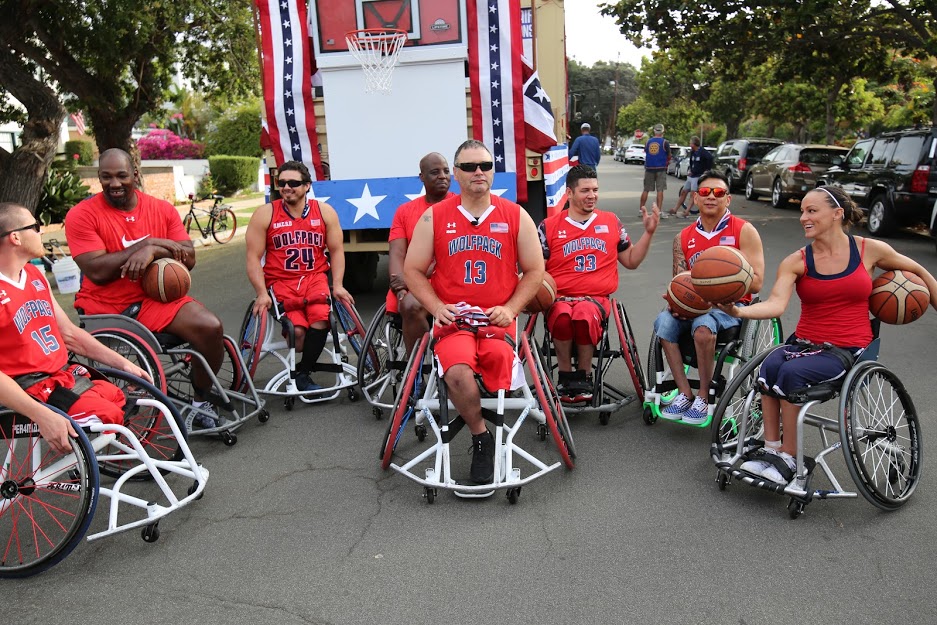
But also something deeper: a different kind of declaration. Not political—but deeply human.
Wheelchair sport is one of the ways we assert independence—not by asking for permission to belong, but by demonstrating what we are capable of building, achieving, and sustaining at the highest level. It is where autonomy becomes visible. Where effort becomes identity. Where performance speaks for itself.
In that sense, the parallel to 1776 is structural. The colonists didn’t achieve independence the moment they signed the Declaration—they committed to a process that would eventually lead them there. In the same way, when people with disabilities commit to sport, we are making a declaration of intent: independence is something we are still working toward through access, opportunity, and visibility.
Both require persistence against constraint. Both are shaped by resistance. Both are statements of will.
The Declaration of Independence articulated an idea: that self-determination is a right worth pursuing even when incomplete.
So the question I keep coming back to every July 4th is this: if independence is something still proven through access, opportunity, and visibility, who gets to decide when it has actually been achieved?